


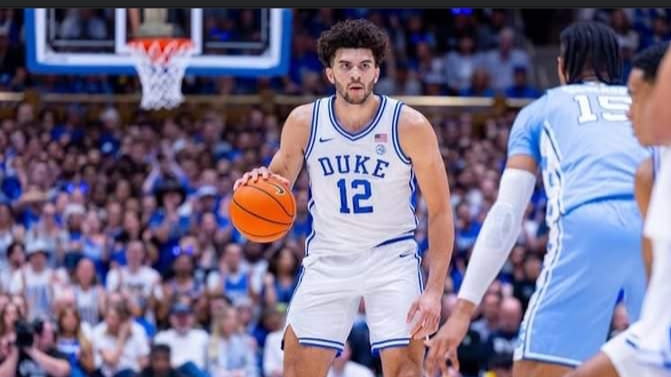
For months, NBA executives searched for reasons to separate the top prospects in the 2026 NBA Draft.
They debated upside. They debated athleticism. They debated long-term potential.
But when it came to Cameron Boozer, one reality kept staring them in the face.
He simply produced at a level few college freshmen ever have.
That is the scary truth NBA teams couldn’t ignore.
The former Duke superstar entered Durham carrying enormous expectations. As the son of former NBA All-Star Carlos Boozer, Cameron arrived with pressure that would have overwhelmed most freshmen. Instead, he made it look easy.
Night after night, Boozer delivered.
Whether it was scoring in the paint, stretching defenses from beyond the arc, dominating the glass, or creating opportunities for teammates, he consistently looked like the most complete player on the floor.
By the end of the season, his numbers were staggering.
Boozer averaged 22.5 points, 10.5 rebounds, and 4.1 assists per game while leading Duke to one of the best regular-season records in college basketball. More impressively, he did it with remarkable efficiency, shooting better than 55 percent from the field while knocking down nearly 40 percent of his three-point attempts.
Those aren’t normal freshman numbers.
They’re numbers typically associated with veteran stars.
The scary part for NBA scouts wasn’t just the statistics.
It was how effortless everything appeared.
Boozer rarely looked rushed. He rarely forced shots. He rarely seemed intimidated by the moment. Even against elite competition, he displayed a level of composure that many professional players spend years trying to develop.
As the season progressed, opposing coaches threw everything at him.
Double teams.
Physical defenders.
Different defensive schemes.
Nothing consistently worked.
When teams focused on stopping his scoring, he became a playmaker. When defenders crowded him on the perimeter, he punished them inside. When opponents tried to outmuscle him, he responded with skill and intelligence.
That versatility became one of the biggest reasons scouts viewed him as a future NBA star.
By March, the conversation had changed.
The question was no longer whether Boozer would be a lottery pick.
The question was how high he could climb.
His dominant postseason performances only strengthened his case. He helped lead Duke to another ACC Tournament championship, earned tournament MVP honors, and added multiple National Player of the Year awards to his growing collection.
Soon, the race for the top of the draft became centered around three names: Cameron Boozer, AJ Dybantsa, and Darryn Peterson.
All three possessed elite talent.
But Boozer offered something unique.
He was one of the safest superstar projections in recent memory.
NBA teams knew exactly what they were getting: production, leadership, toughness, skill, and a relentless desire to win.
That combination is rare.
It’s why the Memphis Grizzlies couldn’t let him slip past the third pick.
For a franchise searching for a new cornerstone, Boozer represented more than just another talented prospect.
He represented stability.
He represented reliability.
And perhaps most importantly, he represented a player whose game translates directly to the next level.
Now, the next chapter begins.
The challenge will be greater.
The competition will be tougher.
But if his Duke career proved anything, it’s that betting against Cameron Boozer is usually a mistake.
That’s the scary truth NBA teams learned during his unforgettable season—and it’s the reason he’s now headed to the NBA as one of the most decorated freshmen Duke has ever produced.
