


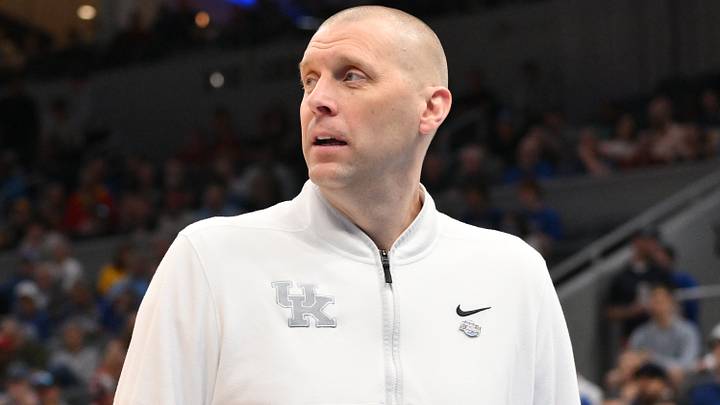
Mark Pope may finally have the kind of roster he has been trying to build since arriving in Lexington. Kentucky appears loaded with shooting, spacing and offensive versatility, giving the Wildcats the potential to become one of the most dangerous scoring teams of the 2026-27 season.
But there is a major question hanging over all that offensive potential.
Can Kentucky defend?
Pope has spent much of his tenure preaching the importance of three-point shooting, repeatedly emphasizing the value of getting at least 30 attempts from beyond the arc. This year’s roster could finally give him a team capable of fully embracing that philosophy.
The Wildcats have plenty of players who can stretch the floor and punish defenses from deep. If the shots fall consistently, Kentucky could be extremely difficult to guard.
Unfortunately, great shooting does not automatically translate into championships.
During a recent appearance on The Field of 68, Pope praised his team’s ability to shoot but offered a more complicated assessment when discussing its defensive identity.
“Everybody in college basketball has gotten so big and physical… That’s not us right now,” Pope said.
That admission could become one of the most important storylines surrounding Kentucky.
Kentucky Plans to Use Length Instead of Physicality
Kentucky may not be built around overwhelming opponents with brute strength. Instead, Pope believes the Wildcats can use their length to disrupt opposing offenses.
“What you’re gonna see with us defensively… you’re gonna see guys open, but it’s going to be really hard to deliver the ball because you’re messing with so much length,” Pope explained.
That’s an intriguing approach.
Rather than expecting Kentucky to completely shut opponents down, Pope appears to envision a defense that makes passing difficult, creates uncomfortable possessions and uses the Wildcats’ size to disrupt passing lanes.
He believes Kentucky has the potential to become a “really, really good defensive team,” but it could look different from the defensive teams Kentucky fans have traditionally seen.
The problem is that potential eventually has to become production.
Kentucky Can’t Afford to Be One-Dimensional
The SEC is filled with physical teams that can attack the paint, crash the boards and make life difficult for perimeter-oriented offenses.
If Kentucky struggles to defend those teams, even elite shooting could fail to save the Wildcats.
That’s especially true in March, when one poor defensive performance can end an entire season.
Kentucky’s offensive ceiling could be extremely high, but the team’s overall ceiling may ultimately depend on how quickly Mark Pope and his staff can turn their defensive length into a reliable system.
Could One More Addition Fix the Problem?
An experienced frontcourt addition could potentially help Kentucky address some of those concerns.
Players such as Mark Mitchell or Cade Tyson would bring experience and additional size to the roster while giving Pope another option when the Wildcats face more physical opponents.
Even one more proven player could provide valuable depth and toughness.
For now, though, Kentucky has to trust the roster it has.
The Wildcats appear to have the shooting. They have length. They have playmaking ability and plenty of offensive potential.
But if Kentucky wants to take the next step under Pope, defense cannot simply be an afterthought.
The Wildcats may have everything they need to become a dangerous team.
They just need to prove they can stop somebody when the shots aren’t falling.
