


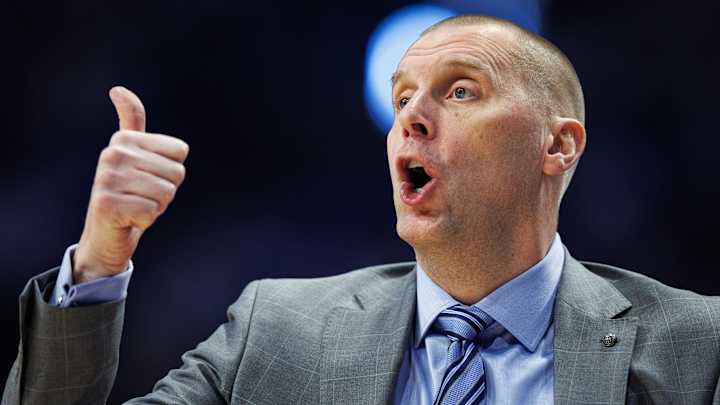
When Mark Pope accepted the Kentucky job, he didn’t walk into it blindly. He knew exactly what kind of pressure, expectations, and scrutiny come with leading one of college basketball’s most demanding programs. And now, two seasons into his tenure, that early awareness is starting to look more like a warning he understood perfectly.
At first, things seemed to be trending in the right direction.
Pope’s arrival in Lexington brought immediate energy. As a former Kentucky player and captain of the 1996 national championship team, he was embraced quickly by much of Big Blue Nation. His introductory press conference at Rupp Arena carried emotion and optimism, signaling a fresh start after the John Calipari era came to an end.
That optimism carried into year one.
Despite not having a roster universally viewed as elite, Pope managed to guide Kentucky to a Sweet 16 appearance. The season wasn’t perfect, but it was enough to restore belief that the program had regained direction and identity. For a moment, Kentucky fans felt like the program was stabilizing again.
But that feeling didn’t last long.
Year two brought a much harsher reality. Injuries disrupted consistency, roster construction came under scrutiny, and performances on the court failed to meet expectations. Losses piled up, momentum disappeared, and frustration began to grow across the fanbase. What once felt like a promising rebuild started to feel uncertain again.
As pressure increased, so did the noise.
Questions about recruiting, development, and Kentucky’s ability to return to championship contention began to dominate conversations. For a program defined by titles and Final Four runs, anything short of elite success quickly becomes a problem.
But here’s the part that stands out most: Pope saw this coming.
According to comments shared by Jeff Goodman on The Field of 68, Pope was fully aware of the reality awaiting him in Lexington. Shortly after taking the job, he reportedly made his mindset clear:
“It’s going to go one of two ways here. If I do well, they will love me. And if I don’t, I know that I’m going to get crucified. But I played here, I understand it, I’ll embrace it.”
That perspective now feels especially relevant.
Kentucky is not a normal coaching job. The expectations are constant and unforgiving. Winning alone isn’t enough—fans expect deep NCAA Tournament runs, top-tier recruiting classes, and, ultimately, national championships.
Anything less invites criticism.
And that pressure has only intensified in recent years as the program continues its chase for a ninth national title. Despite consistently bringing in talent over the years, Kentucky’s championship drought has stretched long enough to turn patience into urgency.
Pope, interestingly, has leaned into that same standard. The pursuit of banner No. 9 is not just a fan talking point—it has reportedly been emphasized inside the program itself. The expectation is present every day, in every practice, and in every conversation surrounding the team.
Still, expectations don’t erase results.
Recent struggles have placed Pope in a more complicated position entering his third season. While there is still respect for his history at Kentucky and appreciation for his transparency, the reality is that the job ultimately comes down to performance on the court.
That’s why year three feels critical.
If Kentucky can rebound, reestablish consistency, and push back into legitimate championship contention, the narrative around Pope could shift quickly. But if the struggles continue, the pressure he once acknowledged from day one may fully come to the surface.
Because in Lexington, nothing stays quiet for long—and Mark Pope knew that better than most when he took the job.
