


The Mark Mitchell saga has taken another dramatic turn, and the latest development could have consequences that stretch far beyond Kentucky and Missouri.
Mitchell, who committed to Kentucky earlier this month after receiving a court injunction that opened the door for him to play during the 2026–27 season, is now returning to Missouri for his fifth season of eligibility.
The decision, announced Monday, comes after Kentucky reportedly became increasingly concerned about potential consequences from the SEC if Mitchell suited up for the Wildcats.
At the center of the dispute is the SEC’s rule governing intraconference transfers outside designated transfer windows. Although Mitchell had received legal relief that allowed him to pursue the opportunity at Kentucky, the Wildcats apparently did not want to risk a larger confrontation with the conference office.
With Missouri’s deadline to enroll in fall classes arriving Monday, Mitchell’s window to reverse his decision was closing quickly. Rather than continue down a path that could have put Kentucky and the SEC on a collision course, Mitchell chose the safer option: returning to Columbia.
For Missouri, the news is enormous.
The Tigers are getting back a player who was considered one of the SEC’s best performers last season. Mitchell immediately gives Dennis Gates another proven weapon and adds even more talent to a roster that already generated considerable excitement heading into the new campaign.
There are questions about how all the pieces will fit together, but on pure talent, Missouri suddenly looks much more dangerous.
For Kentucky, however, the situation is a significant setback.
Mitchell was expected to be an important part of Mark Pope’s rotation and potentially one of the Wildcats’ most impactful players. Kentucky had appeared to put the finishing touches on an impressive roster, and Mitchell’s addition seemed to raise the team’s ceiling considerably.
Now, with the season approaching, Kentucky has lost that piece at a particularly difficult time of the offseason.
Finding a comparable replacement could be extremely challenging this late in the recruiting cycle.
But the bigger story may be what Mitchell’s decision says about the growing power of conferences in college athletics.
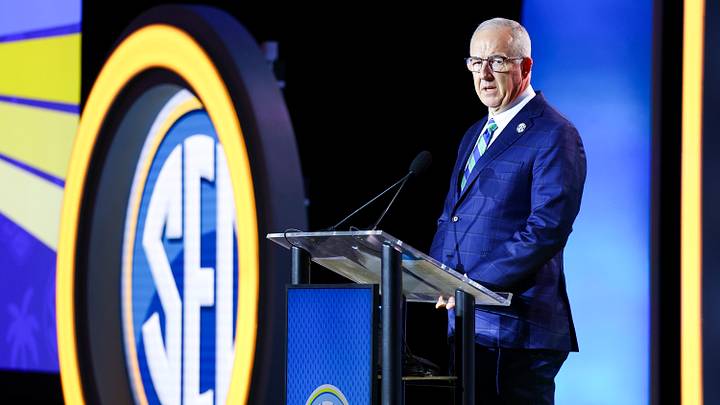
The SEC and commissioner Greg Sankey reportedly refused to retreat from the league’s transfer rules, even when the situation involved one of the conference’s biggest basketball programs.
That matters because college sports are currently dealing with a wave of legal challenges involving player eligibility, transfers and conference authority. Sankey and other power-conference leaders have increasingly pushed the idea that conferences should have greater control over their own rules rather than leaving everything to the NCAA.
The Mitchell situation could therefore be viewed as an important test of that philosophy.
Kentucky ultimately chose not to push the confrontation further, allowing Mitchell to return to Missouri rather than risk potential SEC punishment.
That could be viewed as a victory for Sankey and the league office.
Still, the SEC’s battle over its authority is far from finished.
The league is preparing for another major legal fight involving LSU and football players Dae’Quan Wright and Zxavian Harris, who are seeking eligibility after their involvement with NFL training camps.
LSU’s situation has already generated significant tension within the conference, with reports indicating that the other SEC schools are considering extraordinary measures if LSU proceeds with plans to use the players.
Those possibilities reportedly include refusing to play LSU or even exploring the possibility of expulsion.
Compared with that situation, Mitchell’s case was considerably less explosive. Nevertheless, the SEC had repeatedly reaffirmed its position on intraconference transfers, making it difficult for the conference to suddenly reverse course.
By holding firm, the league sent a clear message: its rules are intended to apply even when one of the schools involved is Kentucky.
For Missouri, Mitchell’s return could become one of the biggest offseason developments in program history.
For Kentucky, it leaves Mark Pope facing a difficult late-offseason challenge.
And for the SEC, the outcome represents something potentially even more important — evidence that the conference may be willing to stand behind its own rules, even when doing so means going head-to-head with one of its most prominent programs.
The larger question now is whether this becomes the beginning of a new era in which conferences, rather than the NCAA, increasingly determine the rules governing college sports.
