


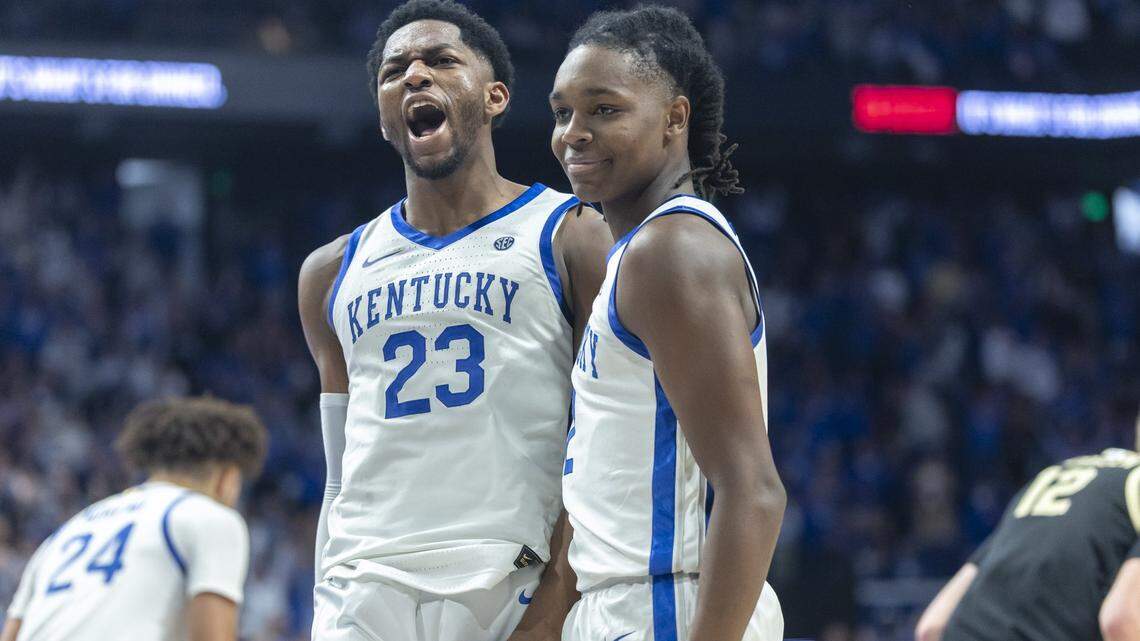
There’s a growing tension in Big Blue Nation, and it isn’t coming out of nowhere. Kentucky’s transfer portal activity has been steady, even productive on paper—but a noticeable trend is starting to make fans uneasy: the Wildcats are stacking depth without landing a clear, undeniable star.
At first glance, the roster construction looks fine. Kentucky has added multiple transfers, including Zoom Diallo, Alex Wilkins, Justin McBride, and Jerone Morton. Each brings useful skills—ball-handling, shooting, defensive energy, and experience in different systems. Individually, these are solid pickups. Collectively, they form a deep rotation that can withstand the grind of a long SEC season.
But that’s exactly where the concern begins.
Kentucky fans are used to a certain formula: at least one elite, game-changing player who can take over when everything breaks down. Whether it was Anthony Davis anchoring a title run or other one-and-done stars defining recent eras, the expectation has always been clear—when the game tightens, Kentucky has the guy.
Right now, that player isn’t obvious.
Instead, the Wildcats are trending toward a “committee approach.” Morton’s production at Washington State—7.8 points, 2.6 assists per game—reflects the profile of many additions: dependable, experienced, but not dominant. That same description can be applied to several of Kentucky’s portal additions. And while that sounds stable, it doesn’t necessarily scream championship ceiling.
That’s where panic starts creeping in among fans.
The worry isn’t that Kentucky got worse—it’s that the team may have gotten safer. Depth can win games in November and January, but March is different. In tournament basketball, close games are decided by shot creation, isolation scoring, and players who can bend a defense on their own. Without that, even well-coached teams can hit a ceiling.
Another layer of frustration comes from the timing. Missing out on high-profile targets, including top-tier recruits like Tyran Stokes, only amplified the feeling that Kentucky is building around Plan B rather than Plan A. Even if the roster is functional, fans are questioning whether it has enough top-end talent to compete with college basketball’s elite.
Still, there’s another side to the story that’s getting less attention.
This approach could be intentional. Modern college basketball is shifting toward older, more balanced rosters. Teams with depth, multiple ball-handlers, and interchangeable scoring options are increasingly difficult to prepare for. Instead of relying on one superstar, Kentucky may be building a system where the advantage comes from unpredictability and rotation strength.
If that vision works, the panic could look premature.
But if it doesn’t, the criticism will be loud and familiar: Kentucky played it too safe in the portal and failed to secure a true alpha.
Right now, the truth sits somewhere in the middle. The roster is deeper. It’s more experienced. It’s arguably more flexible. But it also lacks the obvious centerpiece that fans have been conditioned to expect.
And in Lexington, expectations don’t adjust easily.
That’s why the conversation isn’t calming down—it’s escalating. Because until Kentucky proves otherwise on the court, every portal addition will be measured against the same question:
Is there a star hiding in this group—or is one still missing?
