


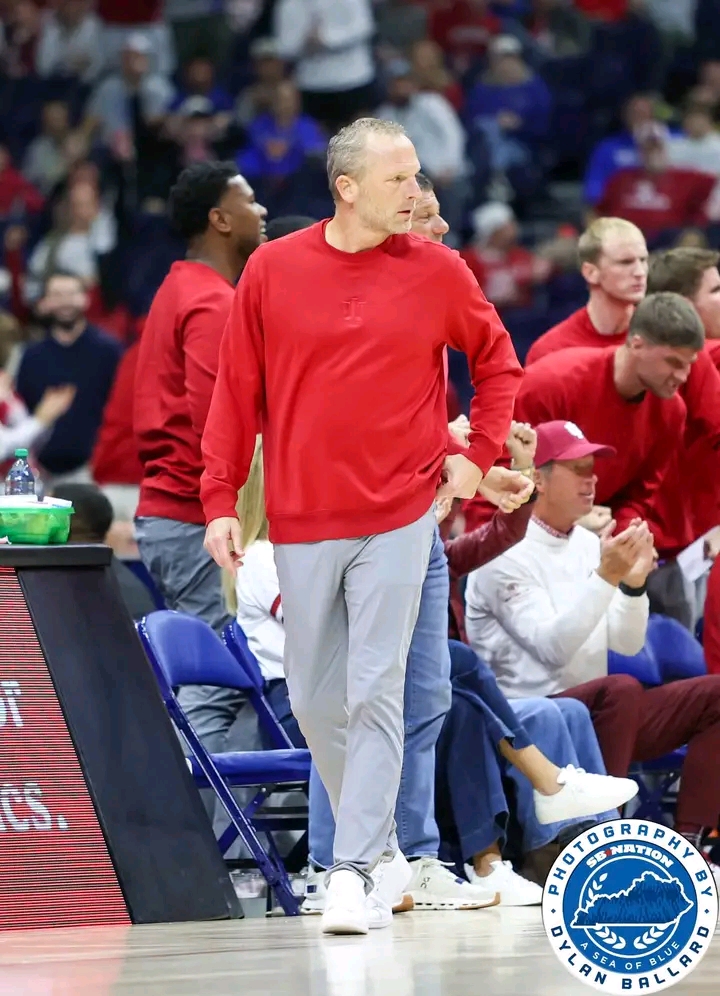
Indiana head coach Darian DeVries may have walked away from Lucas Oil Stadium with a convincing victory over Kentucky, but his postgame comments have created another conversation that continues to attract attention from Big Blue Nation.
Following Indiana’s 90-76 win over the Wildcats on November 20, 2026, DeVries praised his team’s performance while also discussing the future of the historic Kentucky-Indiana rivalry. However, one particular comment has generated plenty of discussion among Kentucky supporters.
DeVries openly admitted that he would love to continue playing Kentucky beyond the current four-year scheduling agreement.
He explained that the rivalry is exciting for everyone involved, highlighting the history between the two programs, their geographical proximity, and the passionate fanbases that make these matchups special.
On the surface, his comments were an endorsement of one of college basketball’s most recognizable rivalries. But considering Indiana had just defeated Kentucky by 14 points, the timing made his remarks particularly interesting.
Kentucky fans are understandably frustrated. Losing to Indiana is never easy for Big Blue Nation, especially when expectations surrounding the Wildcats remain extremely high.
The rivalry represents more than another regular-season basketball game. It carries decades of history, bragging rights, and a level of pride that makes every meeting meaningful.
DeVries also had plenty of reasons to be pleased with his team’s performance. Indiana became more aggressive after halftime, improved its rebounding, and used its depth to maintain physicality against Kentucky’s taller lineup.
The Hoosiers were particularly effective at drawing fouls, finishing 28-of-31 from the free-throw line. DeVries also recognized the contributions of Sam Alexis and Trevor Manhertz, praising the energy they provided off the bench.
Meanwhile, Kentucky has some difficult questions to answer.
The 90-76 defeat puts additional attention on Mark Pope and his team’s ability to compete against quality opponents. Kentucky cannot afford to overlook the defensive and rebounding problems exposed during the matchup.
For Pope, the challenge is making sure this loss becomes a learning experience rather than another source of frustration for an already demanding fanbase.
Interestingly, DeVries’ desire to keep the rivalry alive could actually benefit both programs. These games generate excitement, attract national attention, and give players an opportunity to compete in an atmosphere that few regular-season matchups can replicate.
Still, Kentucky supporters will want something different the next time these teams meet: a Wildcats victory.
DeVries got the result he wanted, but his comments have ensured that the conversation surrounding this rivalry will continue.
And if the two programs meet again, Kentucky will have another opportunity to deliver its response on the court.
