


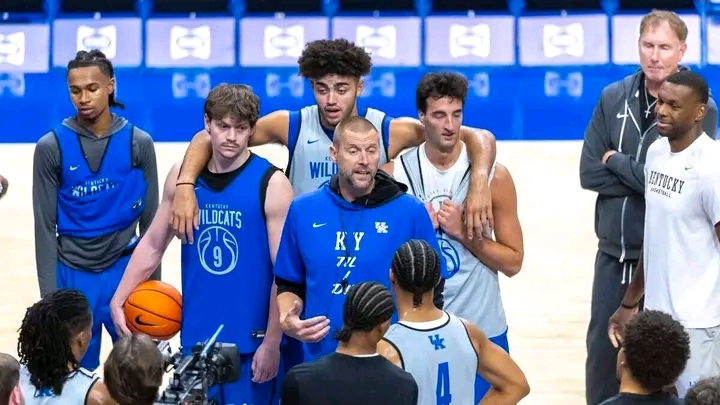
Kentucky Basketball could soon have another opportunity to address one of the biggest challenges facing college basketball programs in the transfer portal era: building chemistry quickly.
The NCAA Division I Men’s and Women’s Basketball Oversight Committees have introduced a legislative proposal that could give teams more opportunities to compete during the summer.
Under the proposal, programs would be permitted to have up to three summer competition dates against other four-year colleges and universities in the United States.
For Mark Pope and Kentucky, that could be a significant development.
More Competition Could Mean Faster Development
The proposed rule would allow teams to use those dates in several different ways. Programs could play an exhibition, participate in a scrimmage, hold a joint practice, or compete in either 3-on-3 or 5-on-5 settings.
Those events could also be private or open to the public.
That flexibility could be particularly valuable for Kentucky because the Wildcats, like many programs around the country, must constantly adjust to roster changes.
Instead of spending the entire offseason learning about his players exclusively through practice, Pope could potentially put his team into competitive situations much earlier.
That would give him an opportunity to see how players respond when the intensity rises.
It could also help him determine which lineups work, which players complement each other and where adjustments need to be made before the regular season arrives.
Kentucky Could Benefit From the Extra Time Together
The transfer portal has changed the way college basketball teams are built.
Coaches can bring in several new players in a single offseason, but adding talent is only part of the equation. Those players still have to learn the system, understand their teammates and develop chemistry.
That’s where the NCAA’s proposal could become especially important for Pope.
Three additional competition dates would provide Kentucky with more meaningful opportunities to test its roster against outside competition.
Rather than waiting until the regular season to discover what works and what doesn’t, Pope could get an early look at his team in situations that more closely resemble actual games.
For a coach trying to build a cohesive roster, those experiences could be extremely valuable.
The NCAA Is Also Considering More Summer Activity
The proposed changes go beyond competition.
The men’s basketball committee is also recommending that the weekly summer limit for athletically related activities increase from eight hours to 10 hours.
The committee cited the amount of roster turnover in college basketball and the additional development time teams need as reasons for the proposed increase.
The three summer competition dates would not count toward that weekly limit.
That could give programs even more flexibility to develop their players while also giving coaches opportunities to evaluate them against other teams.
Nothing Is Official Yet
There is still a process to go through before Kentucky can take advantage of any of these changes.
The proposals could be modified, and the committees are expected to vote on the legislation in December. If approved, the changes could take effect in April.
So, for now, Kentucky fans will have to wait.
But if the proposal becomes reality, it could give Pope something every coach wants in the modern transfer-portal era: more time and more opportunities to turn individual talent into a cohesive team.
Kentucky’s biggest challenge may not simply be finding talented players. It’s making sure those players become a connected unit as quickly as possible.
And if these NCAA changes are approved, Mark Pope could have a new tool to help make that happen.
