


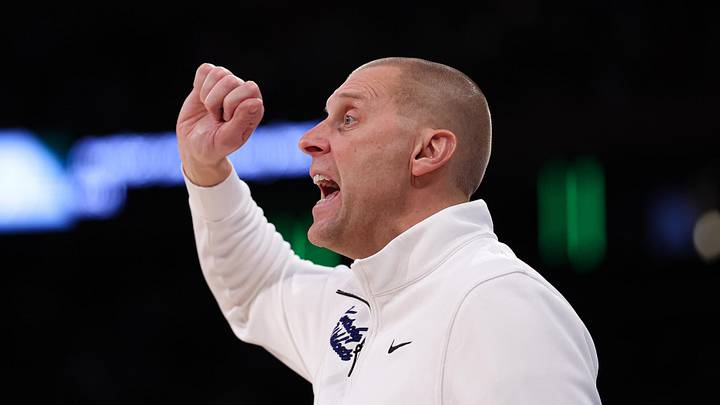
The frustration from Kentucky’s 2025-26 season still lingers across Big Blue Nation. A 14-loss campaign and an early NCAA Tournament exit simply didn’t meet the expectations surrounding the program, and no one understands that more than Mark Pope himself.
But while many fans focused on the disappointing finish, Pope appears to have spent the offseason quietly building a roster specifically designed to correct the team’s biggest flaws.
And honestly, the blueprint is starting to make sense.
Last season’s Kentucky squad often looked talented but incomplete. The Wildcats struggled with consistency at point guard, lacked physicality in certain matchups, and never fully found the right frontcourt balance. Injuries only made things worse, forcing constant lineup changes that prevented the team from developing rhythm.
This offseason, though, Pope’s moves suggest he’s trying to create the exact opposite type of roster.
The backcourt may be the clearest example.
With Zoom Diallo and Alex Wilkins expected to lead the offense, Kentucky suddenly has two experienced guards capable of running the team. Both players averaged over 15 points per game last season, but what really stands out is their playmaking ability. Pope recently pointed out that both guards posted assist rates above 30%, putting Kentucky in rare company nationally.
That kind of ball-handling stability could completely change the Wildcats offensively.
Just as important, both guards bring size and toughness to the perimeter. After struggling at times against more physical SEC teams last season, Kentucky now appears built to better handle defensive pressure and aggressive matchups.
And the depth behind them matters too.
Mason Williams gives Kentucky another steady option off the bench, something the Wildcats lacked consistently during stretches of last season.
The frontcourt construction may be even more intentional.
If Malachi Moreno returns, Kentucky could pair him with international addition Ousmane N’Diaye in a combination that offers both size and spacing. Moreno provides the traditional interior presence, while N’Diaye’s versatility could open the floor offensively.
That balance is something Kentucky rarely had a year ago.
Behind them, veterans Franck Kepnang and Justin McBride bring experience and specialized skills that fit Pope’s vision. McBride’s shooting ability gives Kentucky another spacing option, while Kepnang’s rim protection could anchor defensive lineups when needed.
Instead of forcing awkward rotations with multiple similar big men, the Wildcats now appear to have defined roles throughout the frontcourt.
Of course, questions still remain.
Kentucky may still need one more high-level scoring wing before this roster truly reaches championship-level territory. Names like Milan Momcilovic and Ryan Hampton continue to generate buzz around the program, and adding a player of that caliber could elevate the Wildcats significantly.
Still, even without another major addition, there’s a growing sense that Pope finally has a clearer roster identity.
This team looks deeper. It looks more balanced. And most importantly, it looks intentionally built to avoid repeating the problems that derailed Kentucky last season.
Year three for Pope will carry enormous pressure, but the early vision behind this roster is becoming impossible to ignore.
