


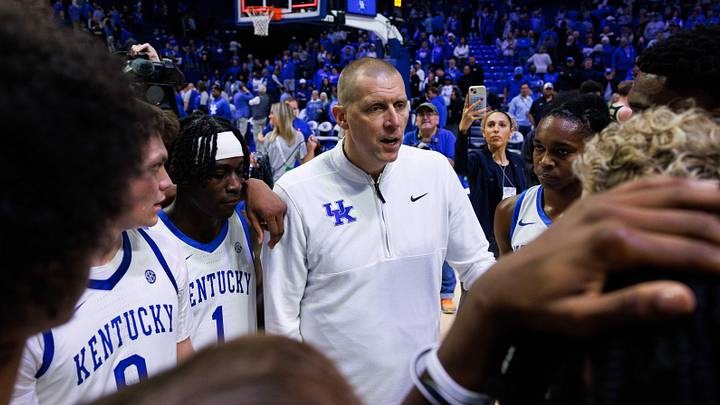
There’s growing frustration surrounding Kentucky basketball’s recruiting under Mark Pope, and the biggest concern centers on a simple but troubling pattern: elite recruits are visiting Lexington, but not leaving with commitments.
From the outside, it’s a confusing stretch for a program that traditionally sells itself. Kentucky is still pulling in top-tier attention, hosting a large number of elite high school prospects, yet the results haven’t matched the interest.
This past season only amplified the pressure. Had Kentucky overperformed on the court, the recruiting struggles might have been easier to overlook. Instead, after a disappointing campaign by program standards, expectations from Big Blue Nation have only sharpened.
The Wildcats have been in strong position with several high-profile names, including Robert Wright, Tyran Stokes, and Donnie Freeman. At one point, fan momentum around those players was intense, with Lexington buzzing about potential “homecoming” storylines. But when decisions were made, none of those prospects chose Kentucky.
Even more striking, 14 of the top 20 high school recruits reportedly visited Kentucky during the cycle, and still, none committed to the Wildcats. That gap between visits and signings has become the central talking point.
College basketball analyst Trey Wallace recently pointed to a possible explanation, suggesting that Kentucky’s issue may not be visibility or resources, but connection. In his view, the Wildcats are doing the hard part—getting elite talent on campus—but struggling to convert those visits into trust and long-term belief.
Wallace emphasized that NIL and roster value are no longer enough on their own. Kentucky can compete financially with anyone, but recruits still want a personal bond with the head coach and staff. Without that relationship piece, even the strongest pitch can fall flat.
The concern has also been echoed by former players. AJ Stewart and Perry Stevenson, speaking on the ARC 360 Podcast, discussed Kentucky’s recruiting struggles and offered their own perspective on Mark Pope’s approach. Stewart, in particular, suggested that while Pope is highly professional and disciplined, his personality may not resonate with every elite recruit in today’s environment.
That kind of feedback adds another layer to an already complicated situation. It raises questions not just about strategy, but about communication and relatability in high-stakes recruiting battles.
Still, the situation isn’t purely about criticism. Pope is operating under significant pressure, tasked with rebuilding a roster, competing in a demanding SEC landscape, and adapting to a rapidly changing recruiting environment shaped by NIL and the transfer portal. Few jobs in college basketball come with this level of expectation and scrutiny.
For all the concerns, one fact remains unchanged: Kentucky is still getting elite players to visit. The challenge now is converting that access into commitments.
And at a program where success is the standard, not the goal, closing that gap is everything.
