


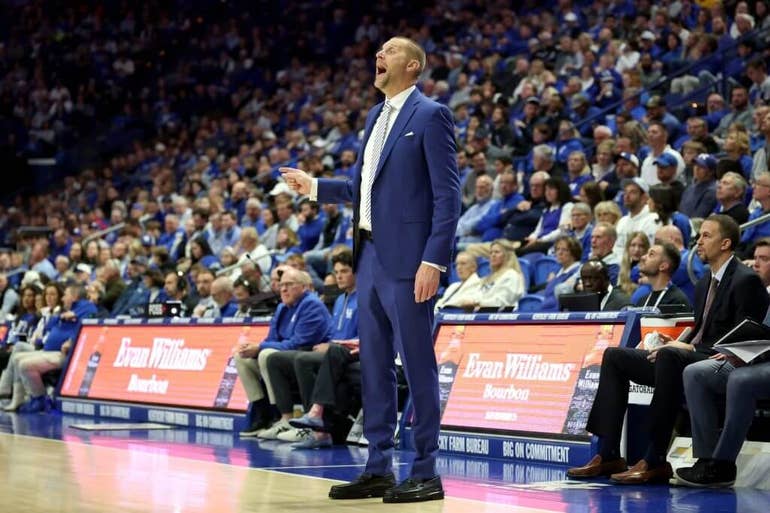
Kentucky basketball’s disappointing start to the 2026-27 season has exposed several problems, but the biggest concern may have very little to do with talent. Instead, it may be whether head coach Mark Pope fully understands the seriousness of the situation surrounding his program.
The Wildcats entered the season with enormous expectations after investing heavily in assembling an expensive roster. However, just two weeks into the campaign, Kentucky is already facing uncomfortable questions about its identity, defensive discipline and ability to compete against quality opponents.
The warning signs became impossible to ignore following Kentucky’s embarrassing 20-point defeat against Kansas in the Champions Classic. Rather than responding with an impressive performance, the Wildcats nearly suffered an unimaginable upset against Northern Arizona at Rupp Arena.
Kentucky needed a last-second three-pointer from sophomore Alex Wilkins to escape with a narrow 78-77 victory against a team expected to finish near the bottom of the Big Sky Conference.
For a program with championship ambitions, that performance was unacceptable.
But Pope’s postgame comments created another layer of frustration.
Instead of delivering the kind of demanding message many supporters wanted to hear, he described the game as entertaining and suggested the team was finding ways to win.
That response raised questions about whether Pope recognizes how far Kentucky is from meeting its expectations.
The Wildcats have reportedly invested more than $20 million in their roster, yet the performances have not reflected that financial commitment. The starting backcourt has struggled with turnovers and creating consistent offensive opportunities, while the team’s overall chemistry remains questionable.
Milan Momcilovic brings valuable three-point shooting, but Kentucky needs reliable playmakers who can consistently create opportunities for him and the rest of the offense.
Defensively, the situation is arguably even worse.
Kentucky has struggled to defend the perimeter, allowing opponents to shoot 36.6 percent from three-point range. Opposing teams are also attempting a remarkably high percentage of their shots from beyond the arc.
These weaknesses have followed Pope throughout his coaching career, and the early performances suggest that significant improvement is still required.
According to KenPom statistics cited in the original analysis, Pope has never produced a top-25 adjusted defensive efficiency team during his seven previous seasons at BYU and Kentucky.
That is particularly concerning for a program expecting to compete for national championships.
Of course, Kentucky’s season is far from over. There is still time for Pope and his coaching staff to make adjustments, improve the team’s chemistry and establish a stronger defensive identity.
However, time alone will not solve these problems.
Pope must demonstrate that he understands the urgency surrounding the program and is willing to make difficult decisions.
Kentucky supporters are not simply demanding victories. They want accountability, improvement and a team that looks capable of competing at the highest level.
The most frightening part of Kentucky’s current situation may not be the losses or narrow victories. It may be the possibility that Pope still doesn’t fully understand how serious the problems have become.
And for a program with Kentucky’s expectations, that is a worrying situation.
