


For much of the offseason, Kentucky basketball’s roster-building strategy under Mark Pope was an easy target for critics.
Rival fans questioned whether leaning into the transfer portal—while mixing in selective high school recruiting—was enough to sustain Kentucky’s traditional status as one of college basketball’s premier programs. The narrative quickly formed: Kentucky was “different,” and not necessarily in a good way.
That narrative is getting harder to defend.
The turning point has been Kentucky’s aggressive and effective work in the transfer portal, headlined by the addition of Iowa State forward Milan Momcilovic. One of the most efficient perimeter shooters in the country, Momcilovic arrives in Lexington after leading Division I basketball with a 48.7% mark from three-point range.
That kind of production doesn’t project—it translates.
Momcilovic immediately changes spacing, floor balance, and defensive decision-making for opponents. His presence alone forces teams to rethink how they guard Kentucky, opening driving lanes and creating cleaner looks for everyone else on the roster. In modern college basketball, that type of shooting is not a luxury—it’s a weapon that reshapes an offense.
And Kentucky didn’t stop there.
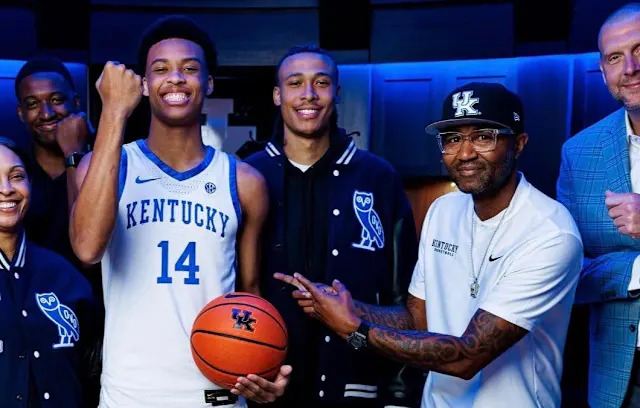
The Wildcats followed up that portal win with another major recruiting victory when five-star wing Ryan Hampton, one of the most highly regarded players in the 2027 class, committed to Kentucky. While not a transfer, Hampton’s decision reinforces a broader truth: the momentum around Kentucky’s roster construction is real, and it is spreading across multiple recruiting channels.
Together, those moves have shifted the conversation.
What was once viewed as a questionable portal-heavy strategy is now looking like a deliberate and increasingly effective blueprint. Instead of chasing hype, Kentucky is targeting specific skill sets—shooting, versatility, and positional size—and securing players who fit that identity.
That approach is also being strengthened by key staff changes. The addition of former NBA guard and head coach Mo Williams has added another layer of credibility and connection in both recruiting and player development. His experience at multiple levels of the game has helped Kentucky build relationships that are now showing up in tangible commitments.
The broader context matters too.
College basketball has shifted dramatically in recent years. National champions have increasingly leaned on experience, continuity, and older players rather than relying solely on freshman-heavy rotations. Kentucky’s portal-driven model aligns with that trend, even if it initially drew skepticism from outside observers.
Now, the results are beginning to speak for themselves.
Momcilovic brings elite shooting. Hampton adds top-tier long-term upside. And together, they signal a program that is no longer stuck debating identity—it is actively building one for the modern era.
Rival fans mocked the approach early on, pointing to uncertainty and change as weaknesses.
But the early returns suggest something else entirely: Kentucky may have adapted faster than most expected.
And in today’s college basketball landscape, that might be the most dangerous development of all.
