


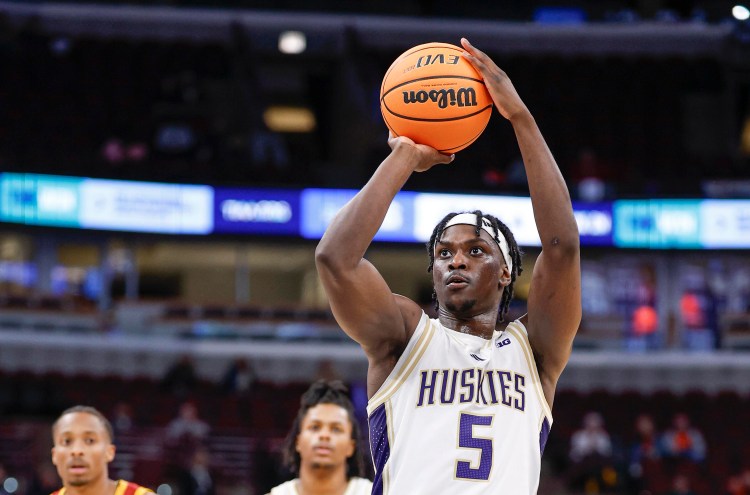
Kentucky’s backcourt is now officially set, barring any late surprises. With the addition of Washington State transfer and in-state product Jerone Morton, Mark Pope has assembled a trio featuring Morton, Zoom Diallo, and Alex Wilkins — three experienced guards expected to stabilize and elevate the offense.
At first glance, it looks like a major win. Kentucky needed playmakers, and this group brings production, confidence, and versatility. But a deeper look at their tendencies reveals a concern that doesn’t quite align with Pope’s preferred style.
The issue isn’t about skill — it’s about shot selection.
All three guards rely heavily on creating their own offense, particularly through pull-up jumpers in the midrange. In today’s game, that’s a red flag. Modern analytics strongly favor shots at the rim and beyond the arc, while midrange attempts — especially off the dribble — are typically the least efficient.
The numbers back it up. Morton, Diallo, and Wilkins have combined for 335 dribble jumpers compared to just 196 catch-and-shoot attempts. That gap highlights a clear preference for isolation and pull-ups rather than playing off the ball and generating cleaner looks.
That becomes even more notable when you consider Pope’s system.
Pope has consistently emphasized efficiency and volume from three-point range. During his time at BYU, his teams were built around spacing, ball movement, and generating open catch-and-shoot opportunities. He’s even publicly pushed for hitting the 30 three-point attempts per game mark — a philosophy that clashes with a midrange-heavy backcourt.
So where does that leave Kentucky?
There are two possible paths forward. One is that this trio proves efficient enough from the midrange to make it work. If they can consistently knock down those shots, they could exploit defenses that are willing to give up space inside the arc.
The other path is adjustment. Pope could look to reshape their approach, emphasizing quicker decisions, more off-ball movement, and a shift toward catch-and-shoot opportunities instead of pull-ups.
Neither option is guaranteed to succeed.
If the players buy in and evolve, this backcourt could become a serious strength. But if their shot profiles remain the same, it risks clashing with the system and limiting the offense against elite competition.
Kentucky has the talent — that much is clear. The real question is whether that talent can adapt to fit the system, or if the system will need to adjust to fit them.
