


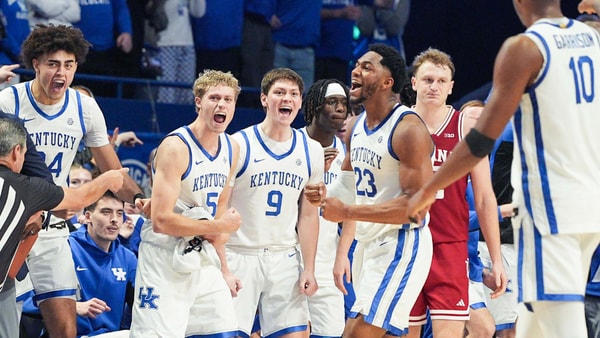
Recruiting hasn’t gone according to plan for Mark Pope and the Kentucky Wildcats, and that reality is becoming harder to ignore. Year after year, Kentucky finds itself firmly in the mix for elite prospects—often even appearing to be the favorite—only to watch those same players choose another destination when it matters most. Caleb Wilson’s recruitment is a recent example that still stings for fans, and now Christian Collins seems to be following a similar script.
With those near-misses piling up, frustration has naturally started to grow. But recently, that frustration has taken a different turn—pointing inward rather than outward.
A narrative has begun to circulate on social media suggesting that Kentucky’s own fanbase, Big Blue Nation, might be playing a role in these recruiting disappointments. The claim, fueled by posts on X, suggests that both Mark Pope and former head coach John Calipari have acknowledged that negativity from fans has, at times, hurt Kentucky on the recruiting trail.
Whether that claim is fully accurate or simply exaggerated, it has sparked a legitimate and uncomfortable debate: could one of Kentucky’s greatest strengths also be a hidden weakness?
There’s no question that Big Blue Nation is one of the most passionate fanbases in all of sports. That passion creates an unmatched atmosphere inside Rupp Arena and gives Kentucky a national presence few programs can rival. For decades, it has been a major selling point in recruiting—players want to perform on the biggest stages, in front of the most dedicated fans.
But the landscape has changed.
In today’s era, fan interaction doesn’t stop at the arena doors. Social media has created a direct, unfiltered line between fans, players, and recruits. Every performance is analyzed in real time. Every mistake can be magnified. And every opinion—positive or negative—is just a click away from the athletes themselves.
That’s where the issue begins to get complicated.
Criticism is part of sports, especially at a place like Kentucky where expectations are championship-or-bust every single season. However, there’s a difference between passionate support and targeted negativity. When frustration turns into personal attacks or constant pessimism, it can shape how recruits perceive the program from the outside looking in.
And make no mistake—recruits are paying attention.
Multiple players over the years have admitted that they see what fans say online. Even if it’s just a vocal minority, the sheer size of Kentucky’s fanbase means those negative voices can feel overwhelming. For an 18-year-old trying to decide where to spend a critical year or two of development, that kind of environment can at least give them pause.
Still, it’s important to keep perspective.
Negative fans are not unique to Kentucky. Every major college basketball program deals with criticism, especially in the age of social media. Programs like Duke, Kansas, and North Carolina all face similar dynamics, yet they continue to land elite talent year after year. That reality suggests fan behavior alone is unlikely to be the deciding factor in recruiting outcomes.
More often than not, recruiting decisions are driven by factors far more concrete—relationships with coaching staff, player development plans, NIL opportunities, roster fit, and long-term NBA potential. In Kentucky’s case, Mark Pope is still in the early stages of building his program. Unlike John Calipari, who had years to establish a clear recruiting identity and pipeline, Pope is still working to define Kentucky’s vision under his leadership.
That transition matters.
Recruits want stability and clarity. They want to know how they’ll be used, how they’ll develop, and how a program will prepare them for the next level. Until Pope fully establishes that blueprint—and proves it consistently on the court—Kentucky may continue to face tougher battles for top-tier talent.
However, perception still plays a role, even if it’s not the primary factor.
If opposing coaches are using Big Blue Nation’s negativity as a recruiting pitch, it becomes part of the conversation. Even if it’s overstated, it plants a seed of doubt. And in recruiting, small doubts can make a big difference.
That’s why this discussion matters.
Kentucky’s fanbase isn’t the root cause of its recruiting challenges—but it’s not completely irrelevant either. At a program where every advantage counts, even minor factors can tip the scales.
In a perfect world, fans would be able to channel their passion in a way that lifts players up without crossing into toxicity. But in reality, that balance is difficult to maintain, especially in a digital era where emotions are immediate and often unfiltered.
For Kentucky to return to consistently landing elite talent, it will take a combination of factors—stronger recruiting relationships, clearer program identity, on-court success, and yes, a fan environment that players and recruits view as supportive rather than overwhelming.
Because at Kentucky, everything is amplified. The spotlight is brighter, the expectations are higher, and the voices—both positive and negative—are louder than almost anywhere else in college basketball.
And whether fans want to believe it or not, those voices are part of the story.
