


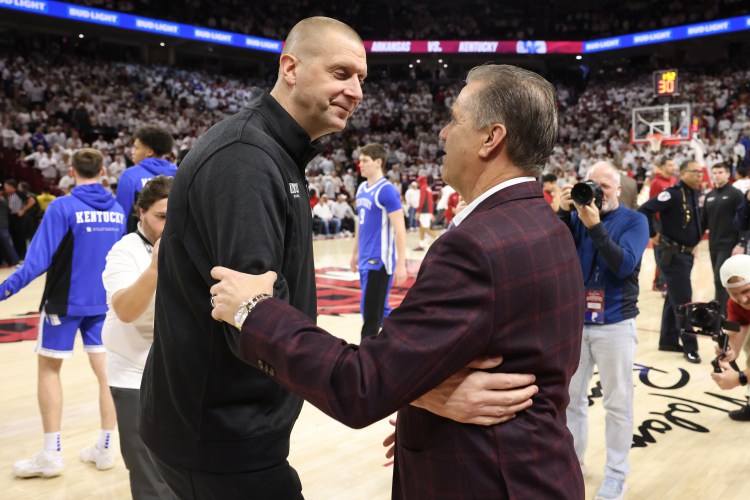
After Arkansas’ Sweet 16 loss to Arizona, John Calipari didn’t hold back when discussing the state of college basketball—and in doing so, he painted a clear picture of the challenges programs like Kentucky are now facing heading into a critical offseason.
In today’s game, stability has become increasingly rare. Between NIL deals, the transfer portal, and constant roster movement, even elite programs are finding it difficult to maintain continuity year to year. Calipari’s comments reflected that growing chaos.
“There are a lot of people who have no recruits, no idea who’s coming back, who don’t have the money you had a year ago,” Calipari said. “Now you’re trying to keep guys, figure out who else is out there, and who wants to put on a bidding war—which we won’t be involved in.”
While some fans and analysts viewed his remarks as a subtle jab at Kentucky head coach Mark Pope—especially after comparisons between their tenures—it’s more likely Calipari was addressing a much larger issue affecting the entire sport. Still, the reality he described hits especially close to home in Lexington.
Kentucky is coming off a season that, on paper, had all the ingredients for success. Reports suggested the Wildcats assembled a roster valued at around $22 million, one of the highest in college basketball. Yet despite that investment, the results fell short. An early exit in the NCAA Tournament, coupled with a disappointing SEC showing, raised serious questions about roster construction, chemistry, and overall direction.
Now, the situation appears even more complicated.
There is increasing belief that Kentucky won’t have the same level of NIL resources available this offseason. Whether due to shifting priorities, donor fatigue, or the evolving NIL market, the financial landscape is no longer as predictable as it once seemed. That means simply outspending competitors for top-tier talent may no longer be a reliable strategy.
Instead, the focus could shift toward retention—keeping key players already in the program who understand the system and culture. In an era where players can leave as quickly as they arrive, continuity is becoming one of the most valuable assets a team can have.
At the same time, the transfer portal remains both an opportunity and a risk. While it offers a chance to quickly upgrade weaknesses, it also introduces uncertainty. Building a roster through transfers often means piecing together players with different backgrounds, expectations, and timelines, making chemistry harder to establish.
For Mark Pope, this offseason could be defining. As he continues to shape the program in his vision, he must strike a delicate balance—retaining core pieces, identifying undervalued talent, and avoiding the kind of bidding wars Calipari referenced.
There’s also the pressure that comes with the Kentucky name. Expectations don’t change, regardless of the challenges. Fans still expect deep tournament runs, SEC contention, and a product that reflects the program’s historic standard. Navigating those expectations while adjusting to a rapidly changing system adds another layer of difficulty.
Meanwhile, Calipari himself is dealing with many of the same issues at Arkansas. His comments weren’t just observational—they were personal. The same NIL limitations, roster uncertainties, and portal battles are challenges he must also navigate as he looks to keep his program competitive.
Ultimately, what Calipari described is the new normal in college basketball: less certainty, more movement, and a constant fight to maintain both talent and financial backing. For Kentucky, the path forward won’t be as simple as it once was.
This offseason won’t just be about adding talent—it will be about managing chaos, making calculated decisions, and finding stability in a system that offers very little of it. And how Kentucky handles it could shape not just next season, but the trajectory of the program for years to come.
