


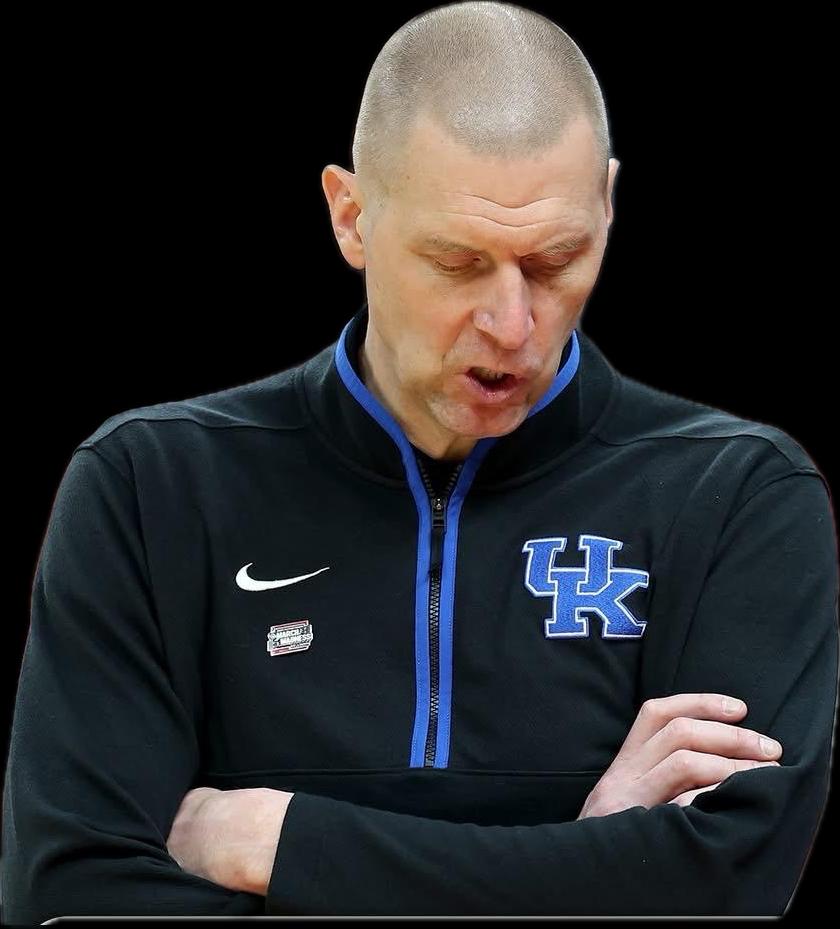
Heading into SEC play with just one true point guard wasn’t just a gamble—it ended up defining Kentucky’s entire season.
After Travis Perry entered the transfer portal and Acaden Lewis decommitted, Mark Pope made the bold decision to center the Wildcats’ offense entirely around Jaland Lowe. That plan quickly unraveled when Lowe suffered a shoulder injury before the season could fully take shape. He attempted a return but was eventually shut down for the year, leaving Kentucky without a true floor general. The result was a stagnant, inconsistent offense that collapsed in a 19-point NCAA Tournament loss to Iowa State.
Instead of fully taking accountability for the roster construction, Pope offered an explanation that has left fans frustrated and confused.
During a postseason radio appearance, Pope revealed that the offense had been completely redesigned to fit Lowe’s left-handed style of play.
“J-Lowe is a left-handed point guard, so we made a conscious decision last spring… that we were going to change the orientation of everything we did,” Pope explained, pointing to how pick-and-roll actions could better align with players’ dominant hands.
From a technical standpoint, the idea has some merit. A left-handed guard attacking left can create better angles, especially for a right-handed big finishing at the rim. But the real issue wasn’t the concept—it was the lack of flexibility.
Lowe was never going to play every minute, even if he stayed healthy. And once he went down, Kentucky continued running an offense built for a player who was no longer on the floor. Pope even admitted the staff stuck with the system before eventually realizing how difficult it had become to execute.
That decision showed up clearly when it mattered most.
Kentucky committed 20 turnovers in its season-ending loss to Iowa State, many of them live-ball mistakes that completely disrupted any rhythm. The struggles extended throughout the season, with the Wildcats ranking 161st in three-point percentage and 81st in effective field goal percentage—numbers that reflect an offense that never found consistency.
Without a true point guard to steady things, Kentucky often looked disorganized, slow to start games, and unable to generate clean scoring opportunities.
The bigger lesson is hard to ignore.
Building an entire offensive system around one player—without securing reliable depth—left Kentucky with no safety net. When Lowe went down, there was no Plan B, and the season spiraled from there.
As Pope heads into a crucial third year, the pressure is mounting. If Kentucky wants to avoid another disappointing finish, it starts with fixing the point guard position and building a system that can adapt—no matter who is on the floor.
