


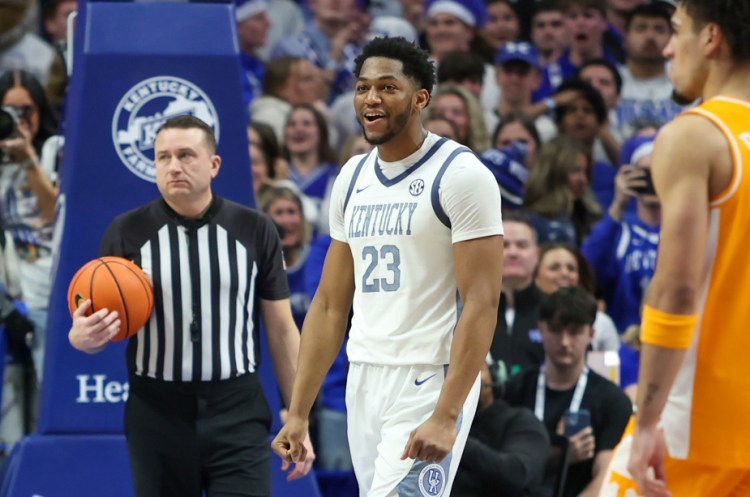
The Kentucky Wildcats are officially winning games in ways that don’t always make sense on paper — and Saturday night’s victory over Tennessee may be the clearest example yet.
Kentucky’s hard-fought win over the Volunteers pushed the Cats to 8–3 in SEC play, continuing a late-season surge that has quietly reshaped how this team is viewed around the conference. It was physical. It was tense. And by most statistical standards, it was a game Kentucky probably shouldn’t have won.
But they did.
Coming into the matchup, much of the conversation centered around Kentucky’s increased physicality and defensive edge under Mark Pope. That growth showed itself late in the game, particularly in how the Wildcats handled Tennessee’s pressure in the final minutes. However, one area told a very different story throughout the night.
Rebounding.
Tennessee dominated the glass from the opening tip, consistently creating second-chance opportunities and wearing Kentucky down inside. By the final horn, the Volunteers had out-rebounded the Wildcats by 15, an eye-popping margin against a team known historically for controlling the paint.
According to Corey Price, that number carries serious historical weight. It marked Kentucky’s worst rebounding margin in a win over an AP Top-25 opponent since the 1998 NCAA Championship game against Utah — the same season that ended with a national title banner hanging in Rupp Arena.
That context makes the result even more stunning.
In nearly three decades, Kentucky hadn’t managed to win a game like this against a ranked opponent. Until now.
And yet, despite being battered on the boards, the Wildcats never folded. When Tennessee appeared poised to take control, Kentucky responded with timely stops, disciplined half-court defense, and clutch shot-making that repeatedly flipped momentum.
This wasn’t a win built on dominance. It was built on survival.
Kentucky’s defense stiffened when it mattered most, forcing Tennessee into difficult possessions late and limiting the damage of those extra rebounding chances. Offensively, the Wildcats made just enough shots at critical moments — the kind of baskets that don’t show up as highlights but decide games in February.
Those moments matter more than ever as the calendar turns toward March.
With a brutal stretch ahead — including matchups against Florida, Vanderbilt, Texas A&M, and Georgia — Kentucky will need to clean up its rebounding issues if it hopes to sustain this run. Elite teams rarely survive long in the postseason while consistently losing the battle on the glass.
Still, there’s something important to take away from this performance.
Kentucky can win ugly.
That hasn’t always been true in recent seasons. In the past, games like this often slipped away when one weakness became too large to overcome. This time, the Wildcats adapted, leaned into their strengths, and found a way through adversity.
It’s not a blueprint for success — but it is a sign of maturity.
Rebounding will be addressed. Adjustments will be made. But confidence gained from surviving a game like this can’t be taught.
The final weeks of the regular season will define this team’s ceiling. And if Saturday night was any indication, Kentucky is becoming the kind of team that doesn’t need everything to go right to win.
Sometimes, that’s the most dangerous version of all.
