


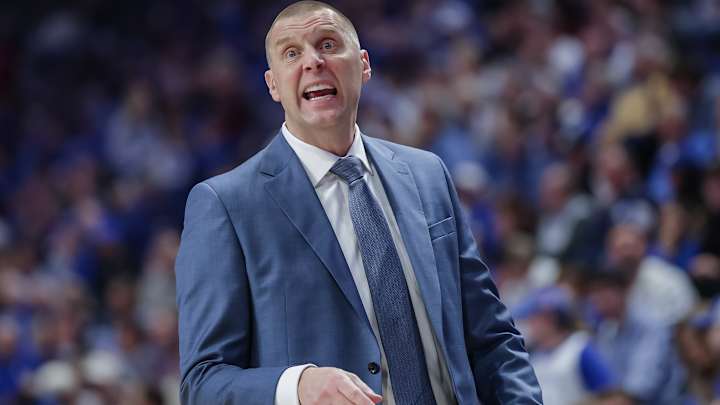
Mark Pope didn’t hesitate when Jasper Johnson’s name came up on his radio show this week. The Kentucky head coach sounded confident—almost relieved—as he explained why the freshman guard has started to look like a completely different player. At a time when the Wildcats can’t afford growing pains, Johnson is beginning to deliver something Kentucky desperately needs: dependable point guard play.
With Jaland Lowe ruled out for the remainder of the season, Kentucky’s margin for error in the backcourt has narrowed. Pope doesn’t need flash or highlight-reel plays from Johnson anymore. He needs stability. He needs decision-making. And over the last couple of games, that’s exactly what he’s gotten.
The stat line against Tennessee tells the story. Johnson finished with 12 points on an ultra-efficient 5-of-6 shooting, added four assists, and committed just one turnover. For a freshman guard in a high-pressure SEC environment, that kind of efficiency isn’t just encouraging—it’s essential.
More importantly, it looked sustainable.
According to Pope, Johnson’s recent growth has come from simplifying the game.
“When he can just be really decisive, it helps him be more forceful,” Pope said. “When he knows what he’s doing, he can really help the team.”
Early in the season, Johnson often looked like a player trying to prove he belonged. Possessions would stall as he hunted one-on-one opportunities, attempting to create something spectacular instead of something effective. That approach led to rushed shots, unnecessary turnovers, and moments where the offense lost its rhythm.
Over the last two games, that version of Johnson has faded away.
Instead, he’s catching the ball with purpose, making quicker reads, and attacking advantages rather than forcing them. The game has slowed down for him, and as a result, his confidence is translating into production rather than mistakes. That evolution is what separates freshmen who survive January from those who thrive in it.
Kentucky’s frontcourt puzzle remains unsolved
While Johnson appears to be carving out a clear role, Kentucky’s frontcourt rotation is still very much a moving target.
Fans hoping for a settled hierarchy among the bigs may be disappointed. Pope made it clear that there isn’t a locked-in rotation—and there may not be one anytime soon.
“Yeah, it’s very much matchup dependent, scheme dependent, situation in the game, and how guys are playing,” Pope admitted. “That’s a little bit of a position by committee right now.
It’ll probably continue to be.”
That philosophy leaves Trent Noah, Andrija Jelavic, Malachi Moreno, Brandon Garrison, and Mo Dioubate all competing for minutes on a night-to-night basis. Whoever is playing best—or fits the matchup—gets the opportunity.
From an offensive perspective, Noah and Jelavic stand out as players who could benefit from expanded roles due to their ability to stretch the floor and keep defenses honest. Spacing remains a premium for this Kentucky team, especially against opponents that pack the paint.
Don’t rule out Dioubate seeing time as a small-ball five, either. While Kentucky isn’t built to dominate the boards, playing smaller and more versatile lineups could unlock cleaner driving lanes and create better shot opportunities on the perimeter.
This Wildcats team likely isn’t going to win many games by overwhelming opponents with size. Its path forward lies in execution, spacing, and decision-making—areas where clarity matters more than raw talent.
And that’s why Jasper Johnson’s emergence is so significant.
He’s no longer just another freshman trying to survive the rotation. He’s becoming a guard Kentucky can trust. In January, that kind of growth can change the trajectory of a season—and Mark Pope looks like he saw it coming before anyone else did.
