


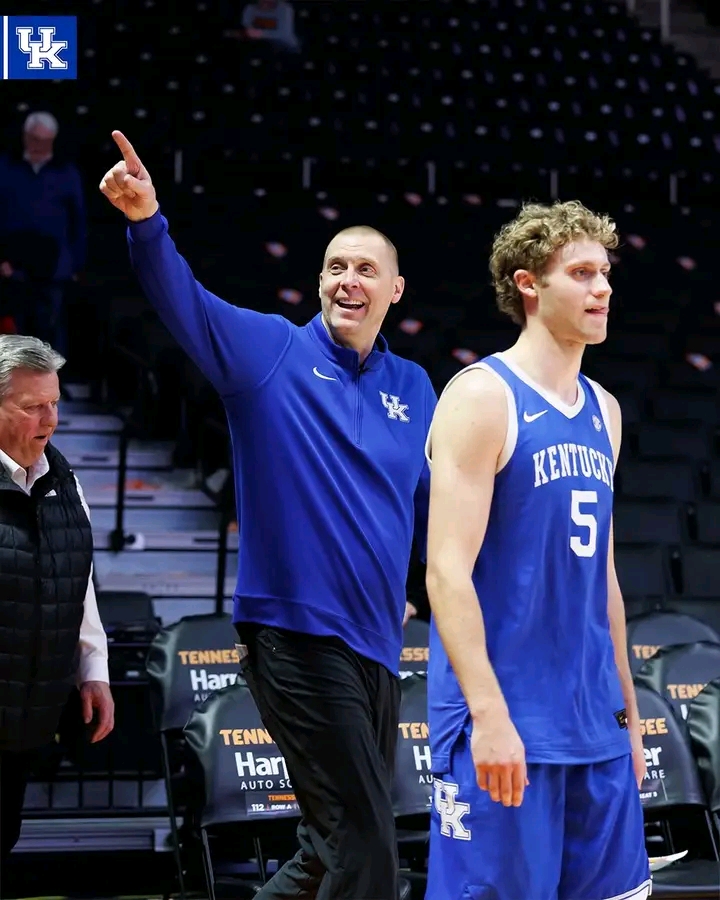
For most of the afternoon in Knoxville, it looked like Kentucky was headed for another painful road loss.
Down 17 points in a hostile Thompson-Boling Arena, getting outworked on the glass, and struggling to generate clean looks offensively, the Wildcats appeared overwhelmed by No. 24 Tennessee’s physicality and energy. The crowd was roaring. Momentum was gone. Everything was stacked against them.
But then Mark Pope made one subtle decision that flipped the entire game — and almost no one noticed it in real time.
He stopped reacting.
Instead of scrambling lineups, panicking over missed shots, or overcorrecting after defensive breakdowns, Pope trusted the long view. He leaned into Kentucky’s second-half identity rather than chasing quick fixes in the first half. And that choice quietly changed everything.
The Move: Trusting the Locker Room, Not the Scoreboard
At halftime, Kentucky trailed by 11. On paper, that’s alarming. In reality, Pope treated it like progress.
He didn’t shorten the rotation. He didn’t overhaul the defensive scheme. He didn’t ride a single hot hand.
Most importantly, he kept his players calm.
While Tennessee played as if it had something to protect, Kentucky came out of the locker room playing free — confident that the game would swing if they stayed connected. That belief wasn’t accidental. Pope has spent weeks building it.
“We knew what we had to do,” Collin Chandler said afterward. “There was no panic whatsoever.”
That tone was set by the head coach.
The Ripple Effect: Everything Slows Down
Because Pope didn’t press the panic button, his players didn’t either.
Kentucky committed just one turnover in the entire second half after coughing it up eight times before the break. The Wildcats stopped forcing passes. They attacked Tennessee’s ball-screen defense patiently. They trusted spacing instead of trying to make heroic plays.
The result? Clean looks. Open lanes. And eventually, momentum.
Tennessee, on the other hand, tightened up.
The Bench Move That Quietly Won the Game
Another under-the-radar decision: Pope empowered Mouhamed Dioubate.
Relegated to a reserve role recently, Dioubate could’ve faded into the background. Instead, Pope unleashed him as an energy weapon off the bench. Dioubate dominated the offensive glass in the second half, grabbing four huge rebounds that extended possessions when Kentucky needed them most.
That single adjustment flipped the rebounding battle — and changed the texture of the game.
Second-chance points kept Tennessee’s defense on the floor. Fatigue set in. Rotations broke down.
That’s when Kentucky struck.
Trusting Denzel Aberdeen Late
Pope’s trust didn’t stop there.
Despite foul trouble earlier, Denzel Aberdeen never left the floor in the second half. Pope saw the mismatch potential and stuck with it. The result? Aberdeen scored 18 points after halftime and delivered the biggest shot of the night — a cold-blooded jumper late that pushed Kentucky ahead for good.
That wasn’t luck.
That was a coach recognizing the moment and refusing to overthink it.
The Moment That Proved It Worked
When Collin Chandler jumped the passing lane in the final minute — anticipating Tennessee’s play call before it unfolded — it was the clearest evidence of Pope’s approach paying off.
Kentucky wasn’t guessing. Kentucky wasn’t scrambling. Kentucky was prepared.
Otega Oweh finished the break, Kentucky took its first lead, and chaos followed — but only for Tennessee.
Why This Win Matters More Than the Score
This wasn’t just a comeback. It was proof of concept.
Mark Pope didn’t win this game with a whiteboard masterpiece or a dramatic timeout speech. He won it by building a team that believes the game doesn’t start until the second half — and by trusting that belief when everything said he shouldn’t.
Kentucky didn’t steal this win.
They waited for it.
And if that mindset sticks, this season might be far from ordinary
