


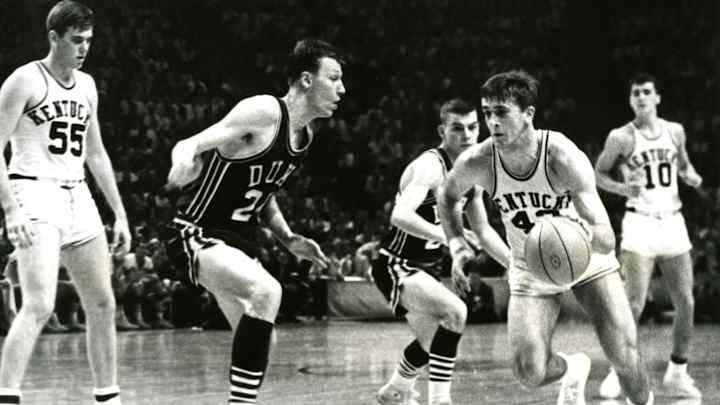
Kentucky basketball has a legacy few programs in college sports can rival. Championships, iconic players, legendary coaches, and a fanbase that treats the game like a birthright — when people think of college basketball, the Kentucky logo is never far from the conversation. That’s why moments like this Saturday matter.
As Mark Pope and the current Wildcats take the floor at Rupp Arena, the program will pause to honor one of its most misunderstood and underappreciated teams: the 1966 Wildcats, forever known as “Rupp’s Runts.” It will be a powerful sight, with former UK All-American Pat Riley expected to be in attendance alongside other surviving members of that historic squad. Larry Conley, due to health reasons, will be the lone living member unable to make the trip.
But honoring Rupp’s Runts isn’t just about nostalgia. It’s about context, truth, and remembering a team — and a coach — far more complex than popular culture often allows.
Understanding the World of 1966 College Basketball
To understand Rupp’s Runts, you have to understand the era they played in.
The mid-1960s were a time of massive social upheaval in America. The Civil Rights Act had passed just two years earlier. The Voting Rights Act was only a year old. College campuses across the South were battlegrounds of change, resistance, fear, and progress happening simultaneously.
In the SEC, segregation wasn’t just a social issue — it was an unspoken rule. The so-called “gentlemen’s agreement” ensured that southern schools neither recruited Black players nor played against them, even when traveling north. No official document spelled it out, but everyone knew the line that could not be crossed.
Just a decade earlier, Georgia Governor Marvin Griffin publicly threatened to block Georgia Tech from playing in the Sugar Bowl simply because Pittsburgh had a Black player. His declaration that “The South stands at Armageddon” sparked riots on campus — all over the right to play a football game. That was the political pressure facing coaches and administrators in the SEC.
This was the environment Adolph Rupp coached in.
The Rupp Narrative Isn’t That Simple
Popular portrayals — especially Glory Road — have painted Rupp as a rigid segregationist. The reality, according to extensive research by historians and journalists like Dick Gabriel, tells a far more complicated story.
Rupp actively recruited Black players long before integration officially reached Kentucky. He and his staff pursued stars like Wes Unseld and Butch Beard. Unseld was scouted more than a dozen times. Beard verbally committed to Kentucky before flipping to Louisville on signing day. This all happened years before Tom Payne finally broke the color barrier in 1969.
Behind the scenes, UK President Dr. Frank Dickey even polled the SEC about ending the gentlemen’s agreement — a proposal that was overwhelmingly rejected. At one point, Rupp asked to leave the SEC entirely so he could recruit freely. The university’s board denied the request, fearing attendance and financial fallout.
Rupp and his staff received hundreds of death threats for recruiting Black players, many of which were forwarded to the FBI. Rupp openly worried about the safety of any Black athlete he might bring to Lexington, knowing the hostility they would face across SEC arenas.
His stance wasn’t about tokenism. Rupp wanted a player strong enough — mentally and physically — to endure the abuse and still help Kentucky win. He simply ran out of time before the world around him caught up.
You don’t have to excuse the era to understand it — but ignoring its realities does a disservice to history.
Small in Stature, Massive in Heart
Lost in the political discussion is the basketball itself — and that’s a shame.
The 1966 Wildcats were called “Rupp’s Runts” for a reason. Not a single starter stood taller than 6-foot-5. Center Thad Jaracz, listed at 6-foot-5, routinely battled opponents half a foot taller. In an era where size mattered immensely, Kentucky was at a clear disadvantage.
It didn’t matter.
That team went 27–2, powered by Pat Riley, Louie Dampier, Larry Conley, and Tommy Kron. They played a brand of basketball that was fast, disciplined, and relentless. They outworked bigger teams, outthought them, and outplayed them.
They stormed all the way to the national championship game.
A Game That Changed the Sport
The title-game loss to Texas Western became one of the most significant moments in college basketball history. The Miners started five Black players — the first team to do so in an NCAA championship game — and they won.
That moment deserved its place in history. But over time, Rupp’s Runts were unfairly framed as a symbol of resistance to progress, when in reality they were a group of undersized players caught in a turning point far bigger than basketball.
They weren’t villains.
They were competitors.
Honoring the Full Truth
This Saturday, when the 1966 Wildcats step onto the floor at Rupp Arena, the moment deserves more than a surface-level narrative. It deserves nuance. It deserves honesty.
Honor the players who defied expectations and played their hearts out. Honor a team that represents one of the most unique runs in Kentucky history. And understand a coach who operated under pressures most today will never fully comprehend.
History is rarely simple — and Rupp’s Runts deserve to be remembered for who they truly were.
