


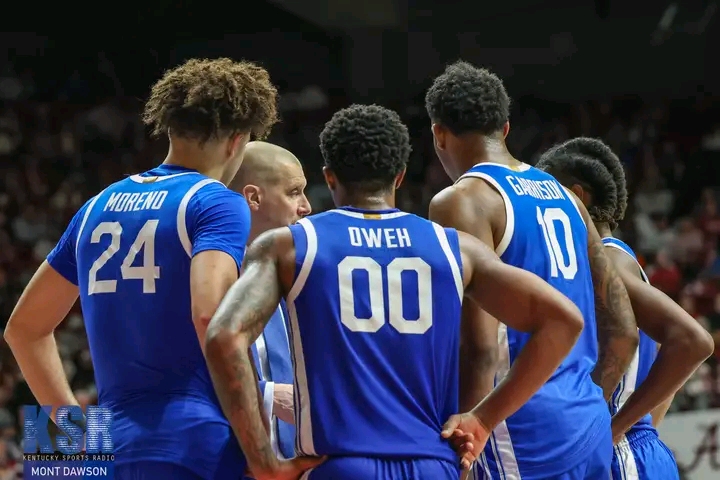
This college basketball season was expected to follow a familiar script. Blueblood programs reloaded through the transfer portal, preseason rankings crowned clear contenders, and the path to March felt predictable.
Instead, everything has unraveled.
Kentucky’s struggles have drawn the most scrutiny, especially after Alabama’s 89–74 win over the Wildcats in the SEC opener. After that game, Crimson Tide coach Nate Oats delivered a blunt assessment that summed up the mood surrounding the program.
“Kentucky’s not what everybody was hoping they’d be this year,” Oats said.
At 9–5, Mark Pope’s Wildcats are still searching for answers as the season reaches its midpoint. Injuries disrupted the early months, but even with players back on the floor, the problems remain. Jaland Lowe — expected to manage a shoulder injury for the rest of the season — has emerged as Kentucky’s only true point guard. The offense has lacked rhythm, and the defensive improvement promised in the offseason hasn’t consistently shown up.
But Kentucky isn’t alone in its disappointment.
Just two months ago, the Wildcats, Florida, and St. John’s were widely viewed as national title threats. Rick Pitino’s Red Storm topped CBS Sports’ preseason rankings. ESPN had Florida slotted No. 2. Kentucky climbed as high as No. 2 in The Athletic’s rankings after an exhibition win over preseason No. 1 Purdue.
Now, none of the three appear in the AP Top 25.
St. John’s entered the week at 9–5, already matching its loss total from last season’s 31–5 Big East title run. Pitino has openly acknowledged the team’s biggest flaw — a lack of a true point guard — calling it a recruiting miss that has forced players into larger roles than originally planned.
Florida’s situation has been equally surprising. Coming off a 36–4 national championship season, Todd Golden returned the nation’s best frontcourt and added highly regarded guard transfers Xaivian Lee and Boogie Fland.
Instead of elevating the offense, Florida has struggled badly from the perimeter, entering the week shooting just 28.0% from three-point range, one of the worst marks in the country. An upset loss to Missouri in the SEC opener only amplified concerns.
“If we can shoot a little bit better, I think we can be pretty dang good,” Golden said. So far, that improvement hasn’t materialized.
While preseason favorites stumble, unexpected teams have surged to the top of the rankings. Arizona, Michigan, and Iowa State now occupy the top three spots, each succeeding with a different roster-building formula. In the SEC, Vanderbilt has emerged as the league’s biggest surprise. Picked 11th in the preseason poll, the Commodores are undefeated, ranked No. 11 nationally, and suddenly the standard everyone is chasing.
Alabama looks every bit like a contender. Arkansas, led by freshman standout Darius Acuff Jr., is right behind. Georgia, picked near the bottom of the conference, has cracked the Top 20 and leads the nation in scoring with a deep, fast-paced rotation.
The transfer portal and NIL era have created more roster-building paths than ever before. Kentucky, Florida, and St. John’s were praised throughout the offseason for their approaches. On paper, the moves made perfect sense.
At the halfway point, the results tell a different story.
There is still time for all three programs to recover. Nate Oats believes Kentucky’s talent will eventually surface. Pitino remains confident St. John’s can continue to improve. Golden insists Florida is closer than the record suggests.
But as January unfolds, one thing is clear: this college basketball season has gone completely off the rails — and Kentucky is far from the only shock.
