


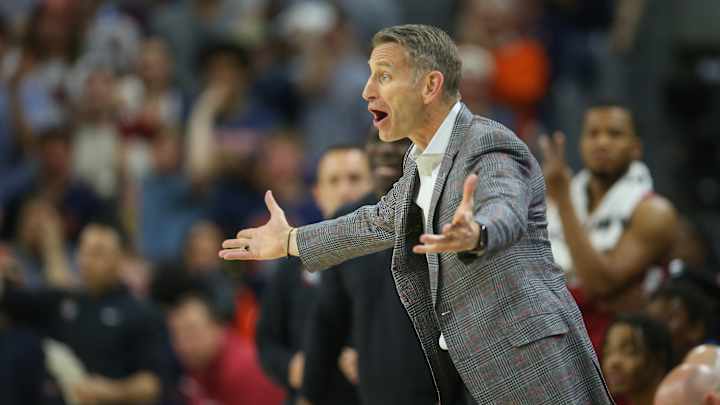
Well, there ya go, folks. After Alabama’s blowout of Kentucky, Alabama coach Nate Oats didn’t hold back — and his target was Mark Pope’s Wildcats. While he didn’t explicitly say the word “fraudulent,” his critique left little doubt about what he thinks
“When I watched them play, I didn’t feel like they moved the ball great… You look at their assist rate — it looks high on paper. But do a deeper dive — 27 assists against weaker teams that play a lot of zone. When they face high-level competition, their assist numbers drop drastically.
And Oats isn’t wrong. Kentucky’s offense has struggled against quality opponents all season:
Louisville – 14 assists
Michigan State – 13 assists
North Carolina – 8 assists
Gonzaga – 12 assists
Indiana – 10 assists
St. John’s – 13 assists
Alabama – 9 assists
After Saturday’s game, Pope defended his team, saying Kentucky “isn’t a team that should ever have 9 assists.” But the stats tell the story: against good competition, the Wildcats struggle to move the ball. Part of the problem is poor shooting — Kentucky is making just 33% of its 3-pointers this season, with only Collin Chandler and Trent Noah over 38%. Even when players make the right play, the shot often doesn’t fall. That creates a cycle where players lose confidence, try to do too much, and end up turning the ball over or taking poor shots — a pattern that’s plagued Kentucky all year.
Oats didn’t stop there. “When they drive, they’re looking to score. They’re not really looking to move it. We’re looking to move it,” he said. Watching Kentucky attack the basket, the goal seems to be only getting a shot up — passing and team movement take a backseat.
He also pointed out Kentucky’s lack of playmaking from the frontcourt: “They throw it into the bigs, they’re not really passing.” This season, the six frontcourt players on Kentucky’s roster average just 4.8 assists per game — including Trent Noah, who had only 1 assist per game and didn’t even play against Alabama. By comparison, last year Amari Williams and Andrew Carr combined for 4.9 assists per game on their own. The roster may be different, but Pope’s approach remains the same.
If Kentucky hopes to turn things around and secure a spot in the tournament, the team will need to make open shots at a much higher rate — reminiscent of the COVID year, when a talented group of players struggled to function as a cohesive team.
Nate Oats isn’t the only one raising eyebrows at Kentucky’s offense. Click here to see which parent is calling for a new approach.
