


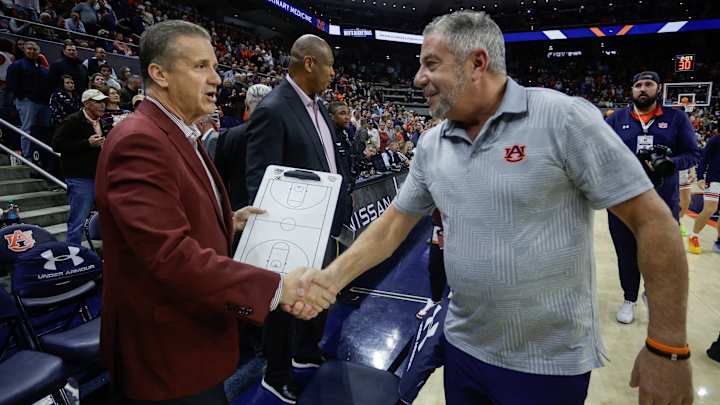
John Calipari and Bruce Pearl aren’t supposed to agree on anything.
They represent two entirely different brands of college basketball power. Calipari is the polished architect — a master at building programs, shaping narratives, and turning a microphone into a moment. Pearl is raw energy — relentless, emotional, and unapologetically loud, the kind of coach who feeds off chaos rather than avoids it.
They’ve competed, clashed, rolled their eyes at each other, and spent years embodying opposing philosophies about how the sport should look and feel.
So when both men — independently — are staring at the same horizon and saying, “this system isn’t sustainable,” it deserves attention.
Because that’s not coincidence. That’s a warning sign.
Calipari Isn’t Talking About Control — He’s Talking About Consequences
Calipari’s proposed solution sounds familiar: allow one free transfer, then add structure and limits afterward. Critics often frame this as coaches trying to regain power, but Cal’s actual concern runs deeper.
He’s focused on what happens after the lights go out.
Calipari consistently speaks in human terms, not legal jargon. His fear isn’t that coaches are losing leverage — it’s that players are being pushed into instability they’re not prepared to manage. A player who transfers three or four times may never truly settle academically, socially, or emotionally. By the time eligibility runs out, the degree often isn’t meaningful, and the final school has little incentive to support someone who was barely there.
Then reality hits.
The NIL checks stop. The applause fades. And suddenly a former athlete who was earning six figures is staring at a perfectly normal entry-level job — $45,000 to $55,000 — and struggling to process it. That’s not a low offer; that’s the real world. But for someone conditioned to sponsorships and special treatment, the adjustment can be brutal.
Calipari has been blunt about the mental health implications of that transition. And whether you like him or not, the concern is legitimate: a system that encourages constant movement also encourages incomplete development — on the court, in the classroom, and in life.
Bruce Pearl Is Saying the Quiet Part Out Loud
Pearl’s take goes even further — and much more publicly.
While many coaches avoid the topic, Pearl has pointed directly at collective bargaining as the only long-term solution left. His argument is simple and uncomfortable: if college sports are operating like a labor market, it eventually must be governed like one.
At this point, Pearl argues, there are only two real paths forward:
Option 1: Congress steps in and grants antitrust protections that allow a centralized authority to restore enforceable rules — transfers, NIL limits, and compliance with actual teeth.
Option 2: College athletics admits what it has become. Revenue athletes are labor. Contracts exist. Representation exists. And rules must be negotiated, not wishfully suggested.
Right now, the sport is stuck pretending it’s still amateur with a few exceptions. Pearl’s point is that pretending is what’s making everything more chaotic — and more expensive — by the year.
What Collective Bargaining Would Actually Change
Collective bargaining isn’t a buzzword. It’s a structural overhaul.
If athletes collectively negotiate, the sport gains:
Standardized contracts defining compensation, benefits, and obligations
Transfer rules rooted in contract terms, not loopholes
Real revenue-sharing models instead of booster-driven improvisation
Enforcement mechanisms that resolve disputes legally instead of through PR disasters
Most importantly, it would force honesty. The current system survives on denial — everyone knows it’s broken, but no one wants to admit what it’s become.
Why the “Wild West” Keeps Winning
The reason chaos persists isn’t ignorance. It’s complexity.
Public and private universities operate under different labor laws. Conferences don’t agree on governance. Title IX implications loom over every decision. And defining who the “employer” is opens an entirely new legal battlefield.
Athletic departments aren’t afraid of paying athletes — that’s already happening. They’re afraid of accountability. Because once rules exist, so do consequences.
And right now, there are almost none.
Why This Matters — Even If You Dislike Both Coaches
Here’s the real takeaway: Calipari and Pearl aren’t offering the same fix, but they’re diagnosing the same disease.
Calipari believes the system can still be stabilized with guardrails. Pearl believes the model itself is past saving.
When two coaches with different histories, motivations, and public personas arrive at the same conclusion — this cannot continue as-is — that’s not panic. That’s an industry alarm.
College athletics has been flashing that alarm for years.
Now, even its loudest and most unlikely voices are finally saying the same thing.
