


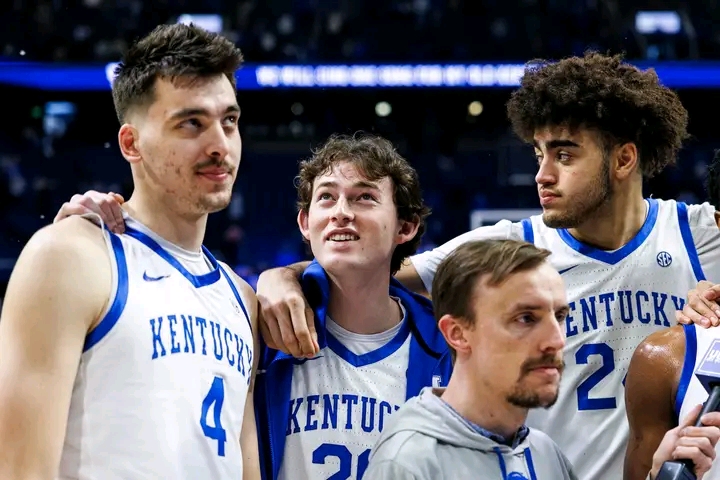
If the Cats want to cut down the nets, these are the margins that matter.
Kentucky’s profile isn’t broken — and that’s the most important thing to understand.
The Wildcats score at a high level, rebound like a contender, and protect the rim as well as almost anyone in the country. A +17.2 scoring margin paired with strong defensive efficiency doesn’t happen by accident. That’s structure. That’s real.
But when the conversation shifts from good to championship, the microscope gets tighter. March isn’t about what you do well — it’s about what gets exposed when games turn ugly, possessions shrink, and every weakness is hunted.
For Kentucky, three areas still separate contender from champion.
1. Kentucky Must Shoot Better From Three — Or Change the Math
Kentucky is shooting 33.7% from three, ranking 173rd nationally.
That number matters because it’s the fastest way great seasons end. One cold night. One defense that packs the paint. One game where the margin disappears.
This doesn’t mean Kentucky needs to jack up 30 threes a night or turn into a volume shooting team. It means opponents can’t feel comfortable sagging off shooters, clogging driving lanes, and daring Kentucky to beat them from the outside.
Championship fix:
Either the three-point efficiency improves, or Kentucky must manufacture better threes. That means more rim pressure, more paint touches, drive-and-kick action, and deeper post seals. You can survive at 33–34% — but only if the looks are clean and the free throws come with it.
Which brings us to the next issue…
2. Kentucky Has to Get to the Free-Throw Line More
Kentucky’s FTA/FGA rate sits at 0.332, ranking 232nd nationally.
That’s a quiet problem — but it’s a costly one.
In March, games slow down. Runs matter. Free throws become oxygen. They stop momentum, punish aggressive defenses, and keep you afloat when shots stop falling. Right now, Kentucky isn’t living at the line the way most title teams do.
It’s also a two-way issue. Opponents are getting to the line at nearly the same rate against Kentucky, meaning the Wildcats aren’t winning the foul-line battle — a huge swing factor in close games.
Championship fix:
Kentucky needs a more consistent downhill identity. Not reckless drives — intentional pressure. Force rotations. Make bigs foul. Punish defenses that reach instead of slide. And when the free ones come, they have to be automatic.
3. Kentucky Must Disrupt Ball Movement on Defense
This one flies under the radar.
On paper, Kentucky’s defense looks strong. Opponents are shooting poorly overall, struggling from three, and finishing at a low effective field goal percentage.
But then there’s this: opponents’ assists per field goal made sit at 0.607, ranking 329th nationally.
That tells a different story.
Teams are still moving the ball comfortably. They’re generating rhythm looks instead of desperation shots. Against average opponents, that’s survivable. Against good teams, it’s dangerous — which helps explain Kentucky’s struggles against power-conference competition.
Championship fix:
Kentucky doesn’t need to gamble more. It needs to take away comfort. Earlier bumps. Sharper closeouts. Cleaner switches. Better communication. Make teams hesitate. Make them hold the ball. Force late-clock decisions and shots Kentucky chooses — not shots the offense wants.
The Bottom Line
Kentucky already looks like a contender.
The Wildcats have the scoring margin, defensive foundation, rebounding edge, and rim protection to make a deep run. Those boxes are checked.
But championships are rarely decided by strengths alone.
They’re decided by what cracks under pressure.
Improve the three-point reliability, win the foul-line battle, and disrupt ball movement defensively — and Kentucky’s ceiling stops being theoretical and starts becoming very real.
