


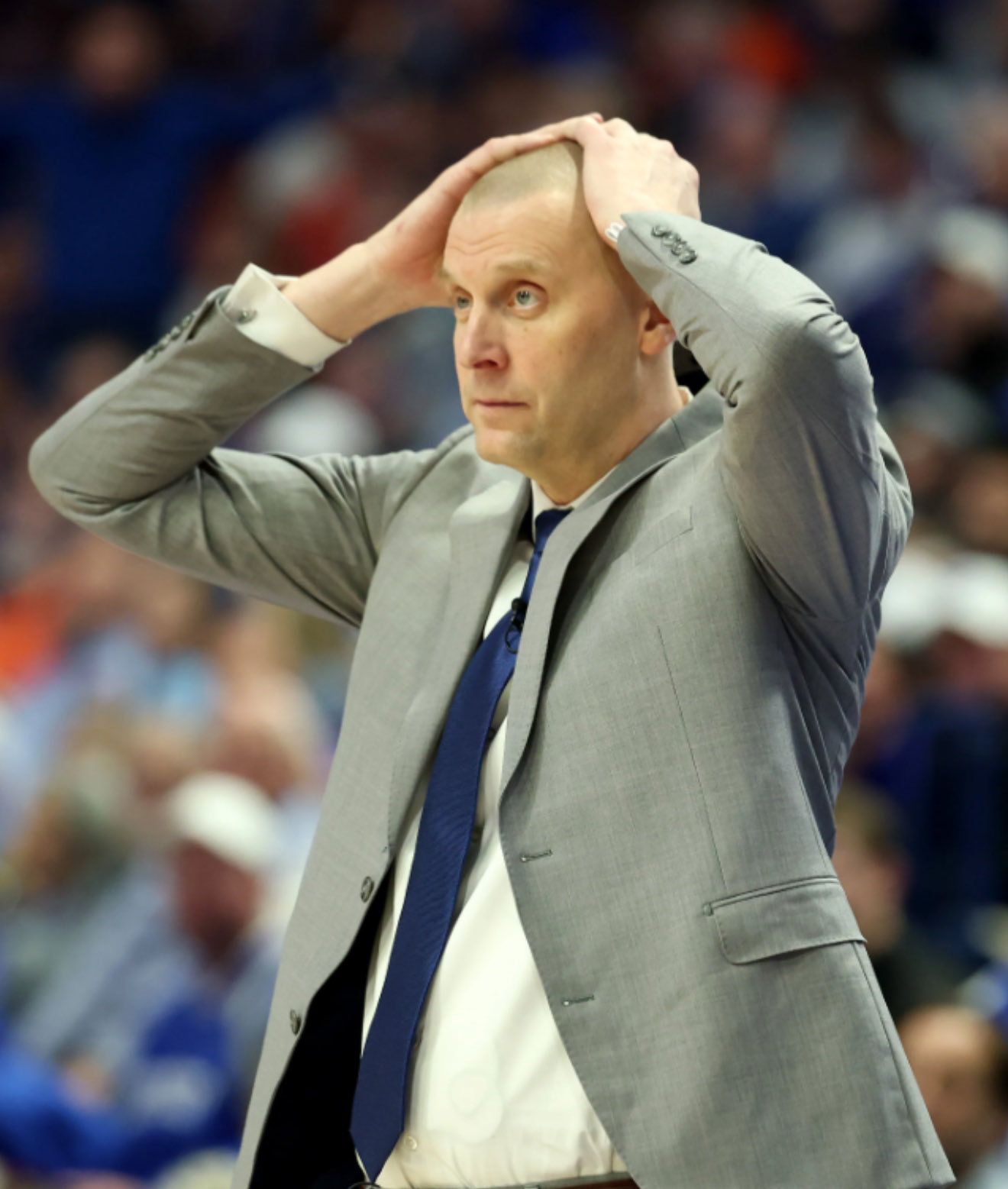
Kentucky basketball’s rocky start has sparked a louder debate than anyone expected: Did Mark Pope misfire when building this year’s roster?
What was billed as a “Ferrari” of a team—one Pope even compared to the championship-caliber groups he once played on—has instead sputtered. A strong exhibition win over Purdue looked promising. Then came the stunning flop: Georgetown stealing one in Rupp Arena. Senior Otega Oweh brushed it off, saying the games “didn’t matter yet,” but that mentality proved to be a preview of deeper problems. If a lack of urgency creeps in once, it usually comes back.
And it did.
Kentucky quickly fell behind by 20 against both Louisville and Michigan State. A furious late rally made the Louisville defeat more respectable, but Michigan State controlled nearly every possession. Pope chalked things up to distractions and poor focus. Heading into the North Carolina matchup, he said fixes were in place—but UNC still dominated the glass, grabbing 20 offensive rebounds. Kentucky endured a 10-minute field-goal drought, yet somehow led late before collapsing again.
Pope keeps preaching patience. Patience, though, is thinning.
Flashback: The roster that worked
Eighteen months ago, Pope built a seamless group centered on shooting, pace, and spacing. Jaxson Robinson hit big shots, Amari Williams orchestrated from the center spot, Lamont Butler created, Koby Brea torched nets, and Andrew Carr stretched defenses. That team beat eight AP Top 15 opponents and reached the Sweet 16 despite devastating injuries.
With a full offseason and elite resources—including reported NIL spending nearing $20 million—expectations for Year 2 skyrocketed.
This season’s pivot: Defense first… but at what cost?
Pope went a different direction this time: more toughness, more defense, more physicality. He stacked the roster with Mo Dioubate, Jaland Lowe, Kam Williams, Denzel Aberdeen, redshirt freshman Reece Potter, and teenage phenom Jayden Quaintance.
Williams and Aberdeen arrived with solid shooting reputations, and Quaintance is already an elite defensive prospect. Pope insisted the offense would be good enough, and that elite defense would carry the team.
Instead, Kentucky is scoring just 72.6 points per game in its three losses, being outrebounded 123–100, and allowing explosive totals like 96 to Louisville and 83 to Michigan State.
Yes, they held UNC to 67—but the Tar Heels were dreadful, going more than 5 minutes without a field goal. Analytics still rate Kentucky as a top-25 team, but this is one of those times where numbers deceive. They’ve crushed mid-majors but fallen flat against every tough opponent.
Pope—never known as a defense-first coach—admits his principles aren’t sinking in. He referenced “stubbornness” and warned that the game humbles players who refuse to play the right way.
Without buy-in, the talent on this roster means little. And with no signature wins, Kentucky now faces a brutal stretch: Gonzaga, St. John’s, and Indiana.
Shooting slump + chemistry issues = disaster
Kentucky’s perimeter shooting has nosedived to 33.6% (72/214), and without Collin Chandler’s 20-for-43 mark, the team would be under 30%. That’s simply not good enough.
Even if Lowe, Dioubate, and Quaintance return soon, the underlying problem remains: the identity shift hasn’t worked. The Wildcats traded shooters for defenders, only to wind up without either a dominant defense or a functional offense.
Pope has tried speeding up the tempo and he’s tried turning up the intensity, but he’s struggling to get this group fully committed. At this point, he can only hope they fear losing more than they fear giving up control.
Did he abandon what made him successful?
Fans now wonder if Pope should have stayed true to his offensive roots. Last season’s blend of shooting, spacing, and creativity produced results. This year’s “bruiser” experiment has only produced frustration.
If adjustments don’t happen fast, this Ferrari may never make it out of the garage.
