


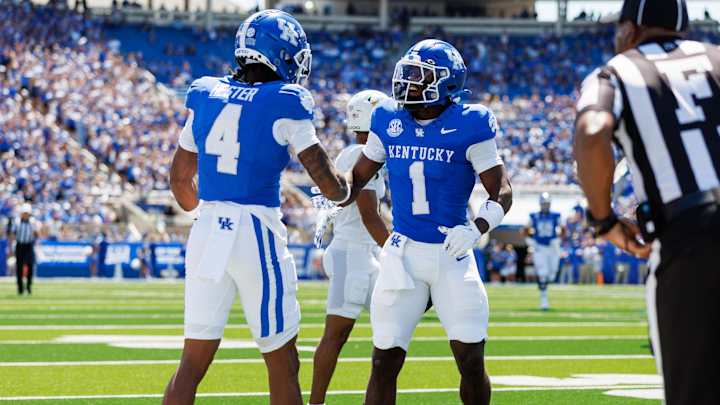
What was once framed as a “great problem” for Kentucky football has now turned into a glaring weakness. The wide receiver room, hyped in the offseason as one of the team’s potential strengths, was a no-show in the Wildcats’ season-opening win against Toledo.
From “Good Problem” to Major Issue
When Offensive Coordinator Bush Hamdan said during camp that there was “no clear separation” in the receiver group, it was interpreted by many as a positive—proof that Kentucky had a deep pool of talent. After Saturday night, that interpretation looks painfully optimistic.
Against Toledo, Kentucky’s passing game was lifeless. The Wildcats managed just 85 yards through the air, with nearly all of it coming from tight ends. The receivers—who were supposed to step up as dynamic playmakers—were almost invisible.
A Brutal Stat Line
The numbers tell the story. Kentucky’s entire wide receiver unit, featuring Ja’Mori Maclin, Fred Farrier II, Hardley Gilmore IV, Troy Stellato, and J.J. Hester, combined for only four catches for 12 total yards. That’s not a typo—12 yards from an entire position group.
A room expected to be deep and versatile was instead flat, unproductive, and unable to win one-on-one matchups. All those “OR” designations on the preseason depth chart now look less like competition and more like indecision.
Context Makes It Worse
This problem isn’t new—but it is getting worse. Last season, Kentucky didn’t have a single wideout surpass 725 receiving yards. Now, after losing their top two targets to the transfer portal, the hole left behind looks cavernous.
Former Wildcat Dane Key shined in his Nebraska debut, hauling in six catches for 51 yards and a touchdown. Meanwhile, Barion Brown recorded five grabs for LSU. Both outproduced Kentucky’s entire receiver room—by themselves—in Week 1.
Pressure Mounts on the Offense
Without receivers who can separate downfield or create explosive plays, Kentucky’s entire offensive balance is in jeopardy. The running game faces stacked boxes, the tight ends face double coverage, and defenses have little reason to respect the Wildcats’ passing attack. Against SEC defenses, this lack of production won’t just be a concern—it will be a fatal flaw.
The Wildcats flipped the receiver room in the offseason, but so far, the results haven’t materialized. This group is talented but unproven, and if Saturday was any indication, “unproven” may quickly turn into “unreliable.”
If Kentucky wants to survive SEC play, someone in this unit has to step up—and fast.
