


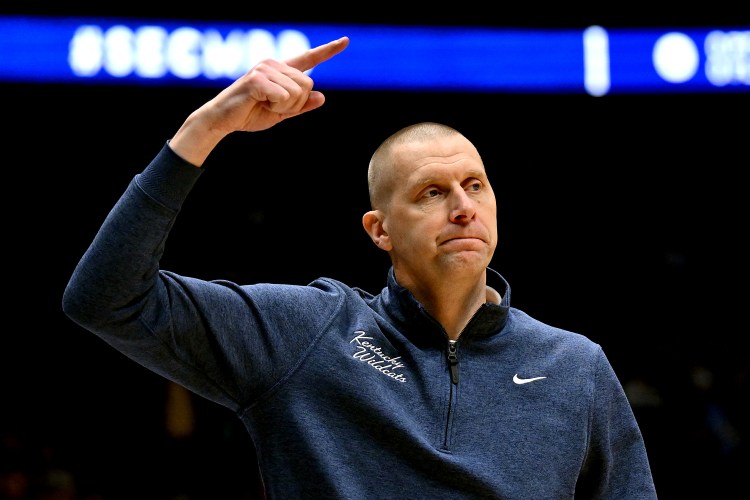
Not long ago, Kentucky basketball flexed its financial muscle like few programs in the country. Nearly $22 million was poured into last season’s roster with the expectation of a deep postseason run. But as things stand now, that investment didn’t translate into long-term stability — and most of that roster is already gone.
Mark Pope is now facing a completely different reality.
With only a small group of returners — including Kam Williams, Reece Potter, and Braydon Hawthorne — Kentucky is no longer operating with the same financial freedom. As confirmed by Goose Givens, the kind of money that fueled last year’s roster simply isn’t there anymore. That shift forces a dramatic change in strategy, moving from heavy spending to calculated efficiency.
And the current transfer portal market makes that adjustment unavoidable.
Across college basketball, player prices have skyrocketed. A top-tier big man can now cost around $5 million, while elite point guards are commanding upwards of $3.5 million. For a program that still needs to fill multiple starting spots and build depth, trying to assemble another “superteam” through spending alone just isn’t realistic.
So Pope is turning to a different kind of edge.
The addition of Keegan Brown as Director of Roster Management could end up being the defining move of the offseason. Kentucky is embracing a data-driven system called the “BLUEprint,” designed to evaluate NIL value, simulate on-court impact, and identify undervalued talent across the portal.
Instead of chasing the biggest names, the focus shifts to finding the right fits — players who can produce at a high level without commanding massive price tags.
It’s a strategy that mirrors the “Moneyball” philosophy: build smarter, not just bigger.
Players like Colby Garland represent the type of targets this system is built to uncover — efficient, productive, and overlooked by programs chasing headline stars. The hope is that stacking enough of these pieces together can create a roster just as competitive as one built on blockbuster deals.
But this approach comes with serious pressure.
There’s virtually no margin for error. If the analytics miss or the projections don’t translate on the court, Kentucky could be staring at a difficult season. The roster is still incomplete, Malachi Moreno is testing NBA waters, and there are no major transfer commitments locked in yet.
In a place like Lexington, that uncertainty can turn into tension quickly.
Mark Pope was hired for his vision, but now that vision is being put to the test sooner than expected. In 2026, success won’t be defined by how much Kentucky spends — it will depend on whether Pope and his staff can identify the players everyone else overlooked.
Because right now, the BLUEprint isn’t just a strategy.
It’s Kentucky’s only way forward.
