


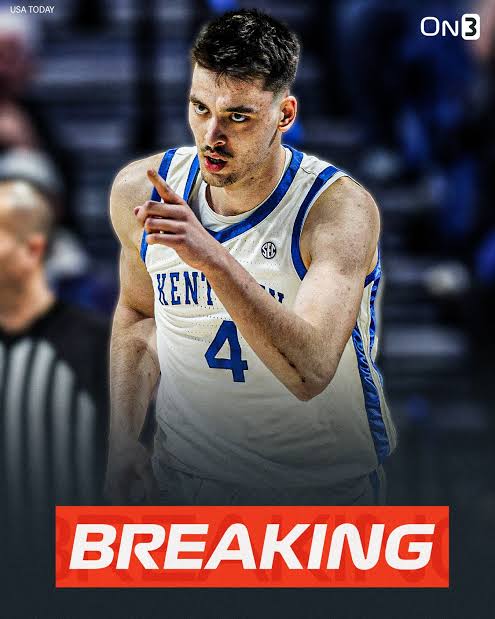
Andrija Jelavic’s decision to enter the transfer portal isn’t just another name added to Kentucky’s growing list of departures—it’s one that raises real questions about fit, development, and direction under Mark Pope.
Jelavic never quite found his footing in Lexington, and a big reason why comes down to how he was used. Pope tried to mold him into a stretch four, a role that didn’t match the player he had been before arriving at Kentucky. The numbers tell the story clearly: Jelavic shot just 21-of-76 from beyond the arc, yet was highly efficient inside the arc, converting 52-of-77 two-point attempts. Despite that, more than half of his shots came from deep—an approach that simply didn’t play to his strengths. In the mid-post, where he was most comfortable, Jelavic showed real promise. But those opportunities were limited.
Now, he joins a growing list of Wildcats heading elsewhere, and his departure adds to a troubling trend.
Kentucky’s roster, particularly in the frontcourt, is unraveling. Jelavic’s exit follows Mo Dioubate, Brandon Garrison, and others, leaving the Wildcats with virtually no returning production up front. Malachi Moreno is testing NBA waters but could return, while Jayden Quaintance is widely expected to go pro. As it stands, Kentucky is staring at the possibility of returning zero meaningful minutes in the frontcourt.
Even beyond the big men, the roster is far from settled. Only a handful of players—Reece Potter, Braydon Hawthorne, and Mason Williams—are firmly locked in. Kam Williams is expected back, though not officially finalized, while decisions from Collin Chandler and Trent Noah are still pending.
This kind of turnover is exactly what Mark Pope was trying to avoid. His system thrives on continuity, chemistry, and players understanding their roles. In Year 1, everything clicked despite injuries, as the roster fit together seamlessly. Role players embraced their responsibilities, and the team found success through cohesion. But Year 2 proved how difficult it is to recreate that formula without stability.
The plan had been to develop a core of younger players who could grow together. Instead, a disappointing season derailed that vision, and now the roster is being rebuilt from the ground up once again.
Jelavic may not have been a star, but he was a player with clear upside—one who could have developed into a reliable contributor with the right usage. Losing him isn’t just about one player leaving; it’s about another missed opportunity in player development.
.
Now, the pressure shifts fully onto Mark Pope. He must rebuild yet another roster, find the right pieces in the transfer portal, and do it quickly. The margin for error is shrinking, and expectations in Lexington haven’t changed.
If this next group doesn’t come together fast, the conversation around Kentucky basketball won’t just be about improvement—it could quickly turn into questions about the future of the program’s leadership.
