


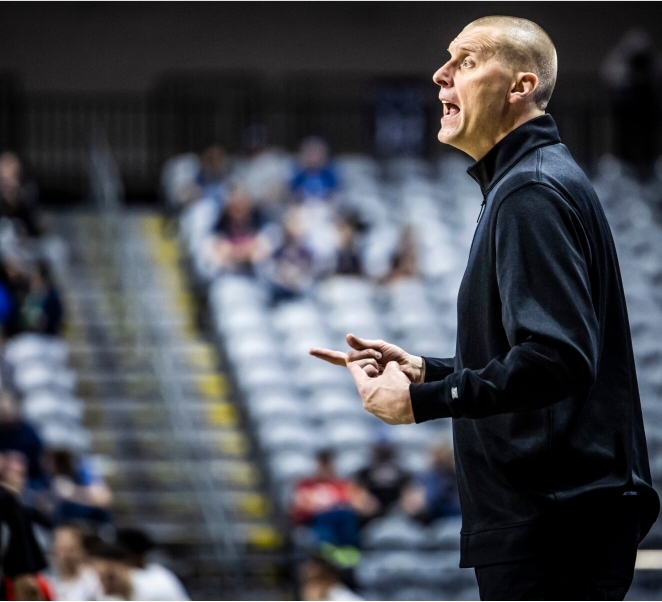
It’s been nearly two years since Mark Pope made the high-pressure leap from BYU to Kentucky, stepping into one of college basketball’s most demanding jobs. Now, with two full seasons in the books for both Pope and his successor Kevin Young, the comparison between the two programs—and their trajectories—has become impossible to ignore.
When Pope took over in Lexington, he inherited not just a roster, but the legacy of John Calipari. Over 15 seasons, Calipari turned Kentucky into a pipeline for NBA superstars, bringing in elite talent like Anthony Davis, Devin Booker, Karl-Anthony Towns, Bam Adebayo, and Shai Gilgeous-Alexander. Replicating that level of recruiting dominance was always going to be a challenge.
Pope arrived with a strong résumé from Utah Valley and BYU, along with deep ties to Kentucky as a former national champion and team captain in 1996. Still, questions lingered: could he recruit at an elite level, and could he win big in March?
Year One: Different Paths, Similar Results
In Pope’s first season (2024–25), Kentucky leaned heavily on experience. Key additions included Travis Perry, Brandon Garrison, Jaxson Robinson, Otega Oweh, Lamont Butler, and Koby Brea—all highly regarded, but not headline-grabbing compared to Kentucky’s past classes. The Wildcats’ recruiting class ranked just 41st nationally.
Despite that, Pope delivered results. Kentucky went 24–12 and reached the Sweet 16 as a No. 3 seed, validating his transfer-heavy approach.
Meanwhile, Kevin Young wasted no time making noise at BYU. He landed elite international prospect Egor Demin, along with Kanon Catchings, Mawot Mag, and Keba Keita. BYU’s class ranked 22nd, signaling a step up in talent acquisition.
On the court, the Cougars matched Kentucky’s success—and arguably exceeded expectations—going 26–10 and also reaching the Sweet 16. For a first-year head coach replacing a long-tenured predecessor, Young’s debut was impressive.
Year Two: Recruiting Gains and Unmet Expectations
Pope made clear progress in his second recruiting cycle (2025–26). Kentucky climbed to the No. 16 class nationally, highlighted by Jayden Quaintance, Kam Williams, Denzel Aberdeen, Mouhamed Dioubate, and Jaland Lowe. It was a noticeable improvement, even if still short of Calipari-era standards.
Young, however, made the biggest splash of all—landing AJ Dybantsa, the No. 1 overall recruit and a likely future NBA No. 1 pick. Even though BYU’s class ranked 24th overall, Dybantsa alone elevated the program’s national profile.
But the 2025–26 season didn’t go as planned for either team.
Kentucky battled adversity early when Quaintance—expected to be a cornerstone—played just four games before suffering a season-ending knee injury. The Wildcats finished 22–14 and entered the NCAA Tournament as a No. 7 seed.
Otega Oweh emerged as the team’s star, averaging 18.6 points per game and delivering a signature 35-point performance in a thrilling first-round win over Santa Clara. But Kentucky’s run ended in the next round against Iowa State, falling short of expectations.
BYU’s season followed a similarly frustrating arc. The Cougars started 16–1 and climbed as high as No. 7 in the rankings, fueled by Dybantsa’s dominant freshman campaign—25.5 points per game, All-American honors, and Big 12 Rookie of the Year.
However, injuries derailed their momentum, most notably Richie Saunders’ ACL tear. BYU stumbled down the stretch, finishing 23–12 and suffering a first-round NCAA Tournament exit as a No. 6 seed. Given the preseason hype, the season was widely viewed as a disappointment.
The Bigger Picture: Pressure Rising
Through two seasons, both programs have shown promise—but neither has broken through in March.
For Pope, the pressure is mounting. At Kentucky, Sweet 16 appearances are respectable, but not the standard. With expectations shaped by decades of success, his third season could be pivotal in determining whether he’s truly the right long-term fit.
Young’s situation at BYU is different but evolving quickly. With elite recruits like Dybantsa choosing Provo, expectations are rising fast. Talent is no longer the issue—turning it into postseason success is.
What Comes Next
Both Kentucky and BYU have reasons for optimism. Pope has improved Kentucky’s recruiting and proven he can build competitive teams, while Young has elevated BYU’s talent level to unprecedented heights.
But in the end, the standard is simple: win in March.
As both programs head into year three under their current leaders, the margin for error shrinks—and the spotlight only gets brighter.
