


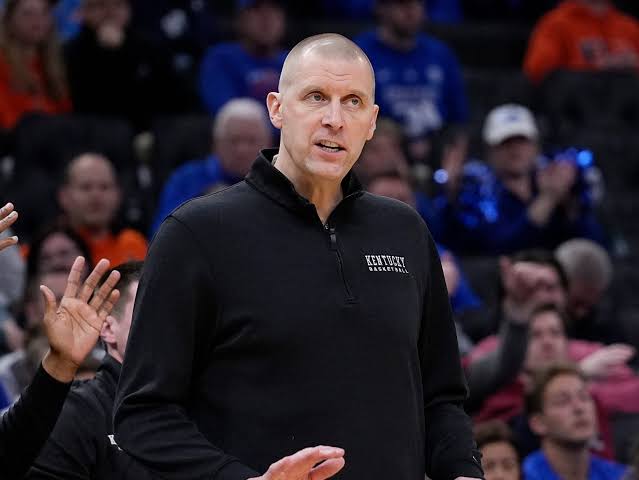
Mark Pope made one thing clear as he wrapped up his final radio show of the season — he wasn’t trying to make excuses. But at the same time, he wasn’t going to ignore reality either.
“This is not an excuse fest,” Pope said. “We know where we need to go. This is just explaining the facts of where we are.”
Those “facts” point directly to one issue that quietly derailed Kentucky’s season: instability at the point guard position.
A Problem That Never Settled
Since arriving in Lexington, Pope has yet to experience a full season with a healthy, consistent point guard rotation — and it’s had a major impact on everything Kentucky wants to do.
In his first season, the Wildcats appeared loaded at the position with Lamont Butler and Kerr Kriisa. But injuries quickly changed that. Kriisa went down for the season, while Butler battled shoulder issues and was limited late in the year.
This past season followed a similar script.
Pittsburgh transfer Jaland Lowe was brought in to run the offense, with freshman Acaden Lewis expected to provide depth. But Lowe suffered a preseason injury, attempted to play through it, and was eventually shut down after repeated shoulder dislocations. Meanwhile, Lewis decommitted before ever suiting up.
Just like that, Kentucky’s entire backcourt plan unraveled.
When Everything Starts to Collapse
Pope emphasized that many of these setbacks were simply unpredictable.
“These are random injuries,” he said. “Not strength or conditioning issues.”
Still, the consequences were undeniable.
With Lowe unavailable and Lewis gone, Kentucky was forced to adjust on the fly. Freshman Jasper Johnson — originally expected to thrive as a scorer — had to take on ball-handling duties. The shift limited his impact and put him in uncomfortable situations.
Denzel Aberdeen, more of a scoring guard, was also asked to run the offense. While he showed effort and growth, he wasn’t a natural playmaker — and it showed in key moments.
The result was a ripple effect that impacted the entire offense.
An Offense That Lost Its Edge
Pope’s system is built on ball movement, spacing, and shot creation. But without a true point guard, those strengths faded.
Kentucky struggled to generate clean looks, rarely created easy scoring chances off pick-and-rolls, and fell short of its goal of high-volume three-point shooting. The Wildcats averaged just 22.4 three-point attempts per game — well below expectations.
“Threes come through ball movement,” Pope said. “And we just lost that.”
The lack of a steady floor general also showed up against defensive pressure. In their NCAA Tournament loss to Iowa State, Kentucky committed 20 turnovers, unable to handle aggressive traps and double teams.
That’s where Lowe’s absence hit hardest.
“With him, pressure turns into opportunity,” Pope explained. “Without him, it’s different.”
The Bigger Issue: Lack of Creators
Beyond the point guard position, Pope pointed to a deeper flaw — a shortage of “creators.”
These are players who can generate offense for themselves and others, a key ingredient in elite teams.
“We are desperate to bring creators here,” Pope said. “The best teams are creator-rich.”
Kentucky had that identity in Pope’s first season. This year, it disappeared.
Even talented pieces like Malachi Moreno and Brandon Garrison couldn’t fully replicate the unique playmaking role that previously helped the system thrive.
A Critical Offseason Ahead
Now, the focus shifts to rebuilding.
Jaland Lowe’s future remains uncertain, and with other backcourt changes expected, Kentucky may need to completely reshape its guard rotation.
The transfer portal will be key, with names already emerging and more expected soon. Pope is also targeting high school talent while reinforcing his system behind the scenes, including the addition of a director of roster management.
Perhaps most importantly, Kentucky will have the resources to compete for top talent.
“We’ll have everything we need,” Pope said.
The Reality Moving Forward
Kentucky’s 22–14 record and early tournament exit weren’t what anyone expected. And while injuries and roster changes played a role, Pope knows that won’t be enough moving forward.
Because whether it was bad luck or flawed depth, the outcome was the same.
The hidden problem is no longer hidden.
And if Kentucky doesn’t fix it — especially at point guard and with more creators — the same issues could define next season too.
