


Coaching at the University of Kentucky has always been one of the highest-pressure jobs in college basketball. But in the era of NIL deals and a constantly shifting transfer portal, that pressure has become even more intense. Mark Pope, who took over the Wildcats in 2024, is experiencing that reality firsthand.
The controversy started in October when the Lexington Herald Leader reported that Kentucky spent roughly $22 million on its 2025–26 roster, including NIL deals. That number immediately put Pope and his staff under a microscope.
Expectations for Kentucky are always sky-high, but when headlines tie a massive financial figure to team performance, the pressure escalates exponentially. Kentucky entered the season ranked No. 9 in the AP preseason poll and predicted to finish second in the SEC behind defending national champion Florida. Instead, the Wildcats struggled to live up to the hype, finishing the regular season 21–13. Even iconic announcer Dick Vitale openly criticized the roster, pointing to a disconnect between money spent and on-court results.
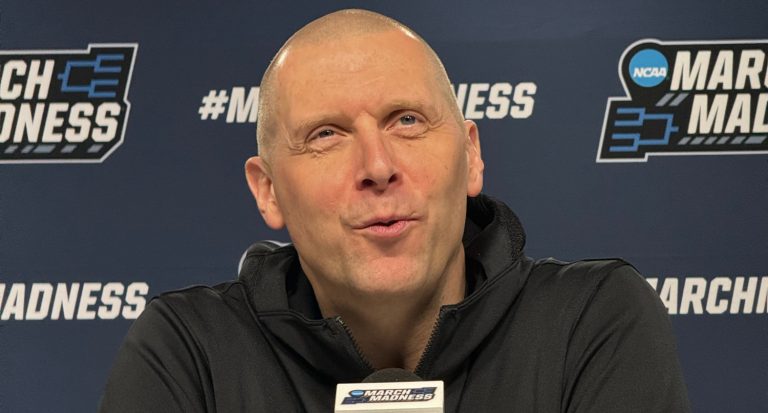
Heading into the NCAA Tournament as a 7-seed facing 10-seed Santa Clara, Pope took the podium at Enterprise Center and addressed the swirling media narratives head-on. While acknowledging that NIL deals do introduce added pressures and distractions, he was blunt about what he sees as the bigger problem: inaccurate reporting.
“In terms of the NIL situation, it might add some pressure to it. I think it definitely adds distraction,” Pope said. “But I do think there’s a chance that accuracy in reporting has taken a massive, massive, massive, insane hit.
On a daily basis, we read things and shake our heads, and we are like, ‘Man, I wonder if anyone actually believes this stuff.’”
Pope elaborated on the blurred lines between reliable journalism and social media speculation, noting that stories are often repeated without verification. “I think part of the problem is that we don’t differentiate between a credible journalist with high ethical standards and someone posting online with no connection to the program,” he said. “It all blurs together, and suddenly things that aren’t true get treated as fact.”
Adding fuel to the fire, Michigan’s Yaxel Lendeborg recently revealed to the Associated Press that Kentucky allegedly offered him $7–9 million before he ultimately signed with the Wolverines. When asked directly whether Kentucky made such an offer, Pope sidestepped the question and returned to critiquing the media environment.
“I know that you guys have to come out here with a headline,” he said. “I am not going to give it to you. But I would appreciate it if there was some segment of the media that actually tries to dig in and report responsibly instead of just repeating what everyone else is saying.”
Pope’s frustration highlights a broader tension in college basketball. NIL deals are increasingly headline-making, but programs like Kentucky face an almost impossible balancing act: recruiting elite talent while managing massive public scrutiny and expectations. Even the most routine media reports can become magnified into national debates about money, fairness, and team performance.
Critics argue that if the $22 million figure were truly inaccurate, Kentucky could have quietly corrected it through backchannel sources or selective media contacts—a standard practice in college sports. The fact that no one tied to the program publicly challenged the figure until now only intensifies speculation.
Despite the off-court distractions, Pope insists that pressure itself isn’t the problem. He thrives in high-stakes environments and embraces the spotlight, calling it part of the Kentucky experience. His main focus, he says, remains keeping his team locked in on basketball. “The pressure is ever-present, and we want it. That’s why we come to Kentucky,” he said.
Now, as the Wildcats prepare for March Madness, all eyes are on the court. A strong tournament run could quickly silence critics and shift the narrative away from NIL spending and media speculation. But if Kentucky falters, the headlines about money, distractions, and “missed expectations” will only grow louder.
For Pope, the story is not just about dollars—it’s about focus, integrity, and controlling what he can in a program constantly under scrutiny. “We will try to embrace the circus nature of this,” he said, “and count on some responsible media member somewhere to actually dig in and find out the truth.”
In the high-stakes world of Kentucky basketball, that truth could define the legacy of Mark Pope’s first full season at the helm.
