


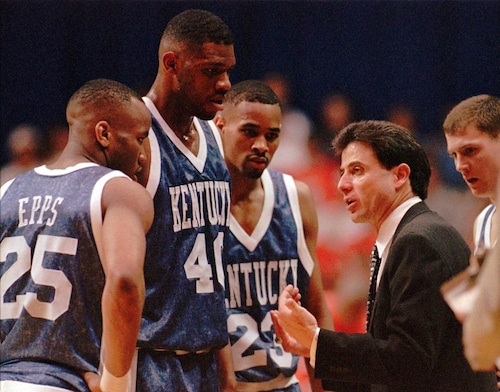
The journey to Kentucky’s 1996 NCAA championship—a team widely regarded as one of the greatest in modern college basketball—began long before the first bracket was revealed. It started with an offseason exhibition tour of Italy in the summer of 1995, where the Wildcats not only faced international competition but also experienced cultural moments, including a visit to Venice and a meeting with Pope John Paul II. Those experiences, Pitino would later say, helped build team chemistry in ways that practice alone could not.
By the time the 1995-96 season rolled around, Kentucky had a locker room filled with NBA-bound talent. Antoine Walker, the sophomore forward and a future NBA All-Star, gave a momentous speech that would define the team’s mindset. “I like to score the most on the team,” he told his teammates. “But I’m willing to do whatever it takes to win a championship.” Pitino recalls that as the point where his team truly became “invincible.”
The Wildcats’ roster was staggering in its depth and talent. Nine of the team’s top 11 players eventually made it to the NBA, six had over 1,000 career points in college, and ten players averaged at least nine minutes per game. No one played more than 27 minutes per contest, ensuring that the team’s energy stayed high and the bench remained as dangerous as the starters.
Building the Untouchables
Kentucky’s 1995-96 season wasn’t about individual talent—it was about selflessness, chemistry, and relentless execution. Cameron Mills, a reserve guard, recalled the transformation: “There was just too much talent, and somehow Coach got us loving each other more than loving our playing time.” That culture of team-first mentality allowed even future NBA stars to buy into a system that prioritized winning over individual glory.
The season didn’t start perfectly. Kentucky had suffered crushing losses the year before, including an Elite Eight blowout to North Carolina, where they scored just 61 points and shot 28% from the field. Pitino knew the team needed to integrate talent with strategy and humility. Players experimented with positions, most notably Tony Delk, who stepped into a point guard role despite being naturally a scorer, and Anthony Epps, who grew from the 12th man to the team’s floor general. Epps’ ability to “set the table” for the NBA-level scorers around him became an early key to success.
The War of Practices
Practice under Pitino was legendary—ruthless, intense, and exhausting. “There were ripped jerseys after every practice,” Mills said. “It was war. It was scary war.” Every player had to earn his minutes; no position was guaranteed. Pitino directed this intensity toward perfecting every detail: press defense, rotations, half-court execution, and conditioning. While fierce on the court, the team remained close off it, bonding through nights of movies, bowling, and team trips during downtime.
The team’s execution became evident early in the season. Epps’ leadership helped Kentucky dominate teams like Georgia Tech (led by Stephon Marbury) and Louisville (DeJuan Wheat), winning by an average of 23 points. SEC opponents were regularly crushed, often by more than 20 points, and the Wildcats’ pressure defense forced turnovers at an astonishing rate.
The Dominance on the Court
By the time the NCAA Tournament arrived, Kentucky’s depth and strategy were unmatched. Future NBA stars like Tim Duncan and Marcus Camby found themselves neutralized by relentless double-teams, rotations, and suffocating pressure. Pitino’s tactical adjustments—targeting low-post stars with immediate double-teams and forcing opponents into foul trouble—allowed the Wildcats to control both pace and outcome.
Even the Final Four tested the team. UMass, led by Calipari’s Allen Iverson-era squad, pushed the Wildcats, but Kentucky’s depth, discipline, and relentless defensive schemes prevailed. Camby and Iverson-era stars were kept in check, and Kentucky’s superior talent, guided by strategic coaching, carried them to the national title.
Legacy and Lessons
Looking back, Pitino said, “I want to coach another ’96 team. It hasn’t happened yet.” The 1995-96 Wildcats weren’t just great—they were a masterclass in talent management, tactical brilliance, and team-first culture. Modern teams can learn from that season: raw talent alone isn’t enough; selflessness, preparation, and relentless execution are what make champions.
1996 Untouchables by the Numbers:
• Record: 34-2
• SEC Record: 16-0
• NBA Players: 9
• Avg. Points/Game: 91.4
• Avg. Opponent Points/Game: 69.4
• Wins by 20+: 20
• NCAA Championship: Yes
The story of the 1996 Wildcats is not just about wins—it’s about the hidden tactics, the “scary war” practices, and the mindset that transformed a group of stars into a single unstoppable unit. And interestingly, those same principles—depth, selflessness, preparation, and smart strategy—are what you see mirrored in today’s championship-caliber teams.
