


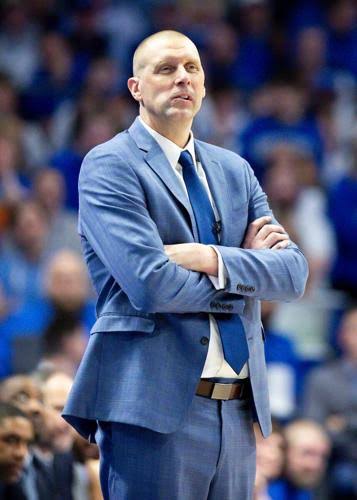
Kentucky’s recruiting struggles are no secret anymore.
As March approaches, Mark Pope and the Wildcats still don’t have a single high school commitment in the 2026 class. That’s the latest Kentucky has gone in a recruiting cycle without landing a senior prospect in more than a decade. Combine that with an up-and-down 2025–26 season, and the anxiety around the program is only growing louder.
What makes it tougher for Big Blue Nation?
Three of Kentucky’s biggest nonconference rivals — Louisville, North Carolina and Indiana — are navigating the new recruiting world with very different strategies. And in some cases, they’re seeing results.
So while Kentucky searches for its recruiting identity under Pope, here’s how its rivals are building.
Louisville: Star Power Now, Flexibility Later
Pat Kelsey is in his second season at Louisville, and while the Cardinals have shown improvement, they’re still fighting for national respect. Louisville is 20–8 overall and 9–6 in ACC play, but struggles against ranked teams have kept scrutiny on Kelsey.
Recruiting-wise, Louisville is in a similar position to Kentucky with the 2026 class — no high school commitments yet.
But the Cardinals already have something Kentucky doesn’t: a proven freshman star.
Five-star guard Mikel Brown Jr., ranked No. 8 nationally in the 2025 class, has delivered immediately. He’s averaging 18.9 points and 4.8 assists per game and dropped 29 points on Kentucky earlier this season. He even set the ACC freshman single-game scoring record with 45 points against NC State.
Brown is projected as a lottery pick, and that kind of success buys goodwill with a fanbase.
Kelsey has taken a different approach overall. Instead of relying heavily on high school prospects, Louisville has targeted older players — including former European professionals and G-League veterans. Twenty-two-year-old London Johnson, a former G-League guard, will debut next season and effectively counts as part of the 2026 build.
The Cardinals also recently shifted a staff member into a general manager-style role, emphasizing modern roster construction through NIL strategy, international scouting and portal evaluation.
Louisville may not be dominating the 2026 high school rankings, but they’re clearly embracing flexibility.
North Carolina: Elite High School Talent Still Matters
While Kentucky is waiting for its first 2026 pledge, North Carolina continues stacking five-stars.
Head coach Hubert Davis has now landed at least one five-star recruit in four straight classes. That includes Caleb Wilson (2025) and Dylan Mingo and Maximo Adams (2026). UNC is selective — often offering fewer than a dozen prospects per class — but when they offer, they close.
Wilson, a 6-foot-10 freshman, has been dominant. He’s averaging 19.8 points and 9.4 rebounds per game and is projected as a top-10 NBA draft pick. In UNC’s win at Rupp Arena earlier this season, he posted 15 points, 12 rebounds and six assists.
For Davis, that immediate production matters.
It allows him to tell future recruits: “You can come here, perform, and become a lottery pick.”
That said, UNC isn’t ignoring the portal. Junior center Henri Veesaar, a transfer from Arizona, has become one of the ACC’s best additions this year, averaging 16.3 points and 8.5 rebounds. The Tar Heels are also exploring international talent, adding guard Luka Bogavac from Montenegro.
Like Louisville, UNC added a general manager last year — former agent Jim Tanner — to oversee roster strategy in the NIL era.
North Carolina is blending elite high school recruiting with portal aggression and international scouting.
Indiana: Portal First, Foundation Second
Darian DeVries is in Year 1 at Indiana and inherited a full rebuild. He retained zero players from last season and brought in 10 transfers to construct his first roster.
The Hoosiers are currently 17–11 and fighting for NCAA Tournament positioning.
Where Indiana differs from Louisville and UNC is its long-term high school strategy.
Rather than chasing one-and-done five-stars, DeVries has targeted multi-year players in the 2026 class. Indiana already has three four-star commitments: Prince-Alexander Moody, Vaughn Karvala and Trevor Manhertz.
The philosophy appears clear: build a sustainable core that develops over time.
That doesn’t mean Indiana is done with the portal — far from it. Expect the Hoosiers to be aggressive again this spring. But their recruiting “sweet spot” seems to be experienced transfers plus high school players who will stay multiple seasons.
Indiana also recently hired a general manager, former Pacers executive Ryan Carr, to modernize its roster-building process.
So Where Does That Leave Kentucky?
Kentucky remains without a 2026 commitment from the high school ranks.
Meanwhile:
Louisville has a lottery-level freshman and a flexible roster model.
North Carolina continues landing five-stars and mixing in portal stars.
Indiana is building a multi-year foundation while leaning heavily on transfers.
Each program has embraced the modern recruiting landscape in its own way — high school stars, older pros, portal veterans, international talent, general managers overseeing it all.
Mark Pope is still trying to define Kentucky’s approach.
Is it elite one-and-done talent?
Portal-heavy roster flips?
International prospects?
A blended long-term model?
Right now, that answer isn’t fully clear.
What is clear is that Kentucky’s rivals aren’t standing still. And in today’s college basketball world — with NIL, revenue sharing and the transfer portal reshaping everything — clarity and direction matter more than ever.
Big Blue Nation is watching closely.
The next few months could define where Kentucky stands in this new era of recruiting.
