


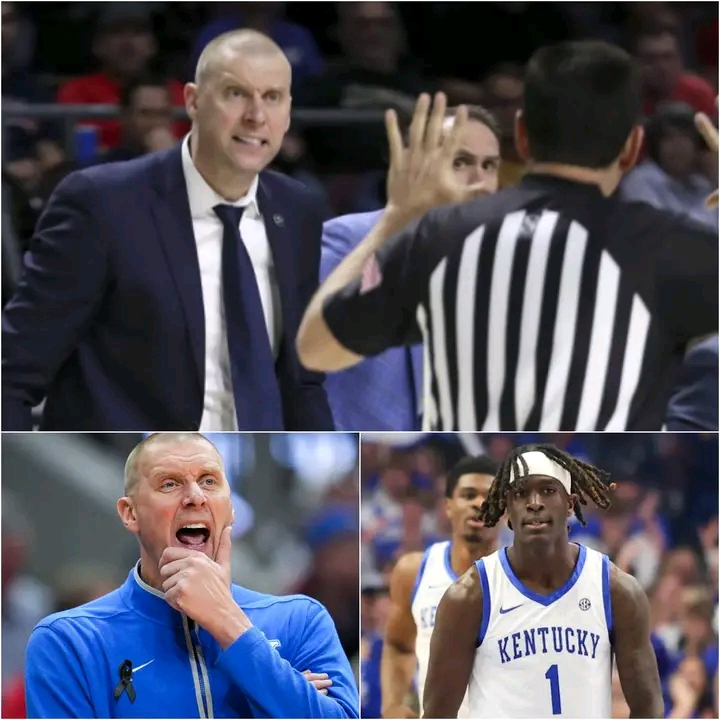
If Kentucky wants to win close games in the SEC, it has to make uncontested shots. It’s that simple. And right now, the Wildcats aren’t doing it.
Mark Pope did what any coach would do — he defended his players. After recent struggles at the free-throw line and missed layups in key moments, Pope suggested fatigue could be part of the issue, pointing to heavy minutes for some of his top guys.
“Been a little bit hit or miss on free throws… Sometimes that’s who’s getting to the line more often. Are you getting your best free-throw shooters there? Sometimes it’s a little bit of a fatigue issue. We’ve been playing some of our guys really, really long minutes…”
It’s understandable for a coach to shield his team publicly. But the numbers don’t back up the fatigue argument.
Layups Are a Decision-Making Problem
Let’s separate the two issues.
Kentucky is shooting just 55.4% on layups this season, according to KSR. That’s not about being tired — that’s about shot selection. Too often, Wildcats guards drive straight into defenders, jump into traffic hoping for a whistle, and toss up low-percentage attempts.
That’s not fatigue. That’s discipline and decision-making.
Heavy Minutes Don’t Equal Poor Free Throws
Against Florida, Otega Oweh (71% FT) and Denzel Aberdeen (80% FT) played 37 minutes each. Collin Chandler (82% FT) logged 34 minutes. Those three combined to go 8-for-12 (66%) from the line. The rest of the team shot 10-for-13.
At first glance, you might say the heavy workload mattered.
But look around college basketball.
Several players average more minutes per game than Kentucky’s guards and still shoot strong percentages from the stripe:
Christian Bliss (Delaware) — 39.4 MPG — 82.9%
Christian Anderson (Texas Tech) — 38.8 MPG — 77.1%
Cruz Davis (Hofstra) — 38.2 MPG — 81.9%
Jake Heidbreder (Fresno) — 36.9 MPG — 89.8%
Michael James (Mississippi Valley State) — 36.8 MPG — 90.9%
Justyn Fernandez (Delaware) — 36.7 MPG — 89.3%
Five of those players shoot as well or better than Kentucky’s top options from the line — while playing more minutes.
Fatigue just doesn’t hold up as the primary reason.
Free Throws Are Mental — and About Reps
Free throws are rhythm. Routine. Repetition.
They’re the one shot in basketball that is completely uncontested. No defender. No chaos. Just mechanics and focus.
Players love to train flashy dribble moves and deep threes, but Steph Curry — the player so many try to emulate — is a career 91.2% free-throw shooter in the NBA. That comes from repetition and attention to detail.
You either put in the work, or you don’t.
The Misses Are Costing Games
This isn’t nitpicking. It’s costing Kentucky in the standings.
Research from 82games once showed that in over 5% of games, the losing team would have won if it simply shot 78% from the line. That can translate to roughly two extra wins per season.
Now look at Kentucky’s losses:
UNC — 3-point loss, 5 missed free throws
Missouri — 5-point loss, 7 missed free throws
Florida — 9-point loss, 10 missed free throws
No team is perfect. But make two more in each of those games — especially in key moments — and everything changes. Momentum shifts. Pressure builds on the opponent. Late-game strategy looks different.
In the SEC, the margin for error is razor thin.
If Kentucky wants to win tight games and make noise in March, it starts at the free-throw line. Not with fatigue. With makes.
