


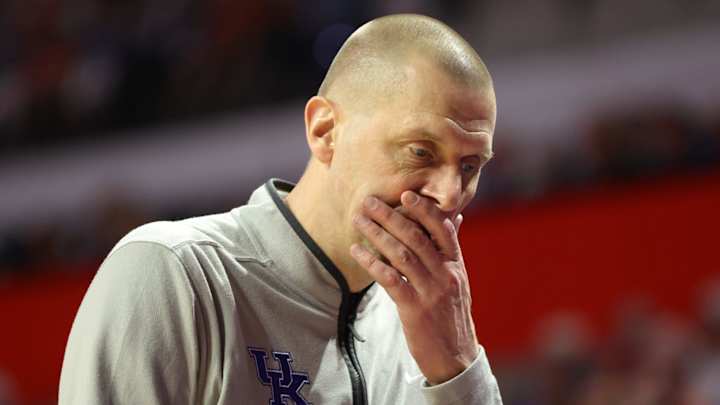
Time to press the panic button.
Kentucky basketball isn’t supposed to have recruiting problems.
For nearly two decades, landing elite talent has been automatic in Lexington. Even during coaching transitions, the Wildcats rarely went a full cycle without securing at least one top-25 prospect. But in Year 2 under Mark Pope, that streak is in serious jeopardy — and the excuses are starting to run thin.
There’s been plenty of finger-pointing. NIL. The JMI structure. The transfer portal. Pope’s recruiting pedigree. But if we’re being honest, the biggest issue might be something far less discussed — and far more difficult to fix.
The Recruiting Drop-Off Is Real
Kentucky invested heavy time and energy into elite prospects like Tyran Stokes, Christian Collins, Caleb Holt, and Bruce Branch III. Early momentum suggested the Wildcats were legitimate contenders, even perceived leaders in some cases.
Now? Kansas and USC appear to be trending for key targets. Kentucky is on the outside looking in.
Outside of the rushed 2024 class that Pope had to assemble in just a few months, Kentucky hasn’t missed on a top-25 recruit in a full recruiting cycle since 2008, when DeAndre Liggins was the highest-ranked signee at No. 33.
That’s nearly 18 years of dominance potentially ending.
That’s not a small dip. That’s a seismic shift.
Is JMI Really the Villain?
Many in Big Blue Nation have zeroed in on the JMI NIL structure as the root of the problem. The argument is simple: the deal limits flexibility and hurts Kentucky’s ability to compete financially with other blue-blood programs.
But the evidence doesn’t fully support that claim.
Take Tyran Stokes, for example. He’s a Nike athlete. Kansas is an adidas school. If NIL alignment were the driving force, Kentucky should theoretically have the advantage — not the Jayhawks.
Meanwhile, current players are landing NIL opportunities whether they opted into JMI or not. Trent Noah opted out and still secured deals. Others inside the structure remain visible in advertisements.
If money were the primary issue, the patterns would be clearer. They’re not.
Is It Mark Pope?
Another theory points to Pope himself. Unlike John Calipari, he doesn’t carry a decades-long reputation as a five-star closer. Maybe he simply doesn’t resonate with elite recruits at that level.
But that explanation feels incomplete too.
National voices like Fran Fraschilla have publicly defended Pope, even saying:
“If you don’t like playing for Mark Pope, something’s wrong with you.”
Players respond to him. He’s energetic. He’s authentic. He believes in his system. There’s little indication recruits are turned off by his personality.
So what’s left?
The Rotation Issue No One Wants to Talk About
Mark Pope is analytics-driven. He prioritizes efficiency, matchups, and keeping players fresh. His rotations are calculated and deliberate. He doesn’t lean heavily on one or two players for 35-plus minutes unless absolutely necessary.
That philosophy may be effective strategically.
But elite recruits don’t just study systems — they study opportunity.
Here are Kentucky’s minute leaders this season:
Otega Oweh — 30.8
Denzel Aberdeen — 28.4
Collin Chandler — 24.8
Malachi Moreno — 22.2
Mo Dioubate — 21.2
Kam Williams — 20.0
Now compare that to Duke, where eight players average at least 19 minutes per game.
And keep in mind — Kentucky’s numbers are influenced by injuries. The Wildcats have missed three starters and two major contributors for extended stretches. If fully healthy, the minutes distribution would likely be even more spread out.
For a five-star prospect evaluating his future, that matters.
Elite players want big roles. They want featured minutes. They want a clear path to being “the guy.” If they look at Kentucky and see a tightly managed, analytics-heavy rotation where minutes are carefully split, they may hesitate.
Derron Rippey Jr.’s recruitment offered a glimpse into that concern. His father openly stated his son wanted a place where he could make a major impact. He chose Duke — where the path to major minutes appeared clearer.
That’s not about NIL.
That’s about opportunity.
The Bigger Concern
The transfer portal can help. It can patch holes and add experience. But Kentucky’s identity has always been built on elite high school recruiting. That pipeline fuels the brand, the hype, and the NBA pathway perception.
If Kentucky misses on a top-25 recruit in a full cycle for the first time in nearly two decades, it won’t be brushed off as a “portal era adjustment.”
It will raise serious questions about structural philosophy.
Mark Pope continues to express confidence. He says Kentucky is in strong position with the players they want. He projects optimism.
But fans aren’t seeing the results yet.
And until commitments follow confidence, the concern will only grow louder.
The brutal truth? This may not be about money or messaging.
It may be about minutes.
