


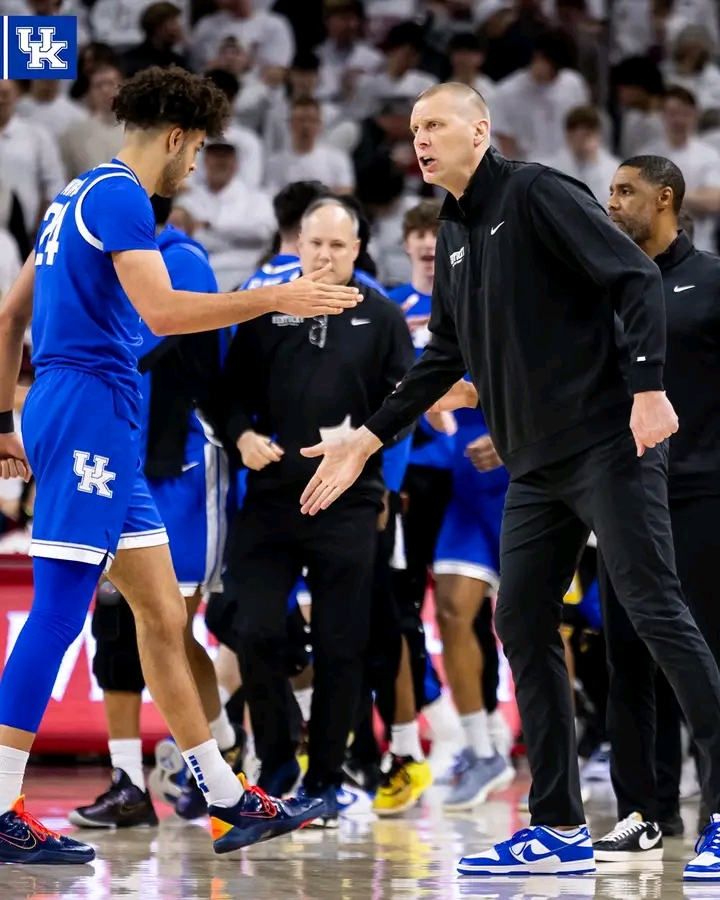
Thirty years later, the secret behind Kentucky basketball’s most dominant team still hasn’t changed.
As members of the 1996 national championship squad reunite inside Rupp Arena this weekend, the memories flowing between them won’t just be about banners, trophies, or blowout wins. They’ll be about pressure. Standards. And one unwavering demand Rick Pitino made that season — a demand Mark Pope is now restoring as Kentucky’s head coach.
There was no negotiating it in 1996. There isn’t now.
For Jeff Sheppard, the story that always resurfaces starts with a win — one that somehow wasn’t good enough.
Kentucky beat Georgia by 13 points at home. Instead of celebration, Pitino ordered a midnight practice.
“That tells you everything,” Sheppard said. “Winning wasn’t the standard. How we won was.
That single decision captures the defining trait of the ’96 Wildcats: accountability without exception.
That team didn’t just dominate college basketball — it suffocated it. Kentucky finished the season with only two losses, won every home game by double digits, and outscored opponents by an average of 22 points per game.
Practices were harder than games. Expectations never relaxed.
And no one — not future NBA stars, not team captains — was above the standard.
The roster overflowed with talent: Tony Delk, Antoine Walker, Ron Mercer, Derek Anderson, Walter McCarty, and Mark Pope, among others. Depth was a weapon. Pressure was constant. But Pitino demanded something more important than skill.
Total buy-in.
“There were no outside voices,” Sheppard said. “No NIL. No social media. We had one voice in our head — Coach Pitino’s.”
Pitino’s practices were relentless, intentionally so. Players competed so fiercely against each other that game days felt easier by comparison. Delk, the team’s leading scorer and the Final Four’s Most Outstanding Player, once joked that practices were “ten times harder than games.”
That wasn’t accidental. It was the plan.
Pope, now standing on the same sideline as Kentucky’s head coach, remembers it clearly.
“Coach put us in a bubble,” Pope said. “He was so demanding that we leaned on each other just to survive. And that’s what made us great.”
The Wildcats played fast, defended aggressively, and rotated freely. They averaged over 91 points per game and forced more than 22 turnovers a night. Teams rarely lasted the full 40 minutes.
But what truly separated Kentucky was time — something rare in today’s college basketball world.
Those players lived together. Studied together. Bowled together. Wrestled each other. Traveled together. Years of shared experiences turned talent into trust, and trust into sacrifice.
“You don’t get that overnight,” Sheppard said. “That’s years of being together.
The season itself unfolded like a statement. Kentucky opened at No. 1, lost early to John Calipari’s UMass team, then rattled off 27 straight wins and earned the nickname “The Untouchables.” In the NCAA Tournament, the Cats crushed their first four opponents before avenging the UMass loss in the Final Four and defeating Syracuse for the national championship.
Pitino won’t be in Lexington this weekend due to coaching obligations at St. John’s, but his presence will be felt — just as his influence is now visible again inside Kentucky’s program.
Because Mark Pope isn’t just honoring that era.
He’s reviving its core demand.
One voice. One standard. No exceptions.
In a modern era full of noise, movement, and ego, Pope is betting that the same principle Pitino enforced in 1996 still wins championships.
History says he might be right.
