


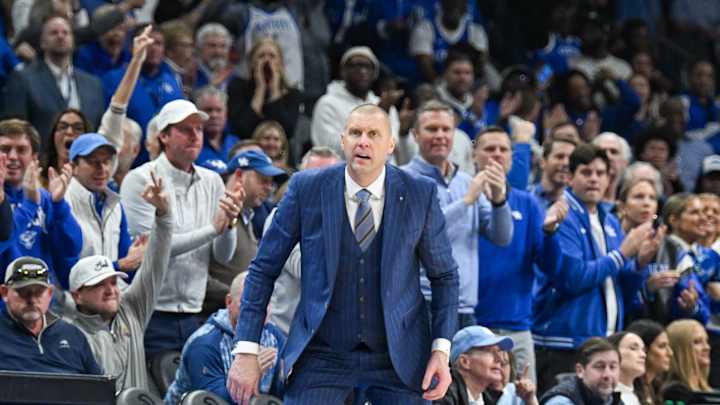
Last season, Mark Pope looked like a coach who had found the right formula.
With a roster pieced together largely through the transfer portal, Kentucky surged to the Sweet 16 despite constant injuries and limited continuity. The Wildcats beat a record eight AP Top-15 teams, took down Duke and Tennessee, and even knocked off eventual national champion Florida. They played fast, spaced the floor, and overwhelmed teams offensively — even if defense was often optional.
Still, the criticism never stopped.
Fans and analysts questioned whether Pope’s finesse-heavy, shooting-based system could ever win a national title. The calls for more size, more toughness, and more physicality grew louder. Instead of doubling down on what had worked, Pope listened — and that decision now threatens to undo everything.
A roster that contradicts the coach’s own philosophy
In the offseason, Pope completely reshaped Kentucky’s identity — or lack thereof. He abandoned shooters and floor-spacing bigs in favor of bulk and interior play. The result is a roster construction that actively works against the system that built his reputation.
Mo Dioubate, Jayden Quaintance, Brandon Garrison, and Malachi Moreno all thrive in the same areas: the low block, rim finishes, and pick-and-roll actions. None are reliable perimeter threats. When your four primary bigs occupy the same offensive space, the floor shrinks — and Kentucky’s offense suffocates.
Trent Noah and Andrija Jelavic provide at least some spacing, but neither has earned consistent minutes. Jelavic has limited range, and Noah’s lateral quickness has made him a defensive liability in Pope’s eyes — to the point that he didn’t see the floor against Alabama.
The irony is painful: Kentucky desperately needs Noah’s shooting anyway.
Shooting woes that define everything
Kam Williams was supposed to be a solution on the wing. Outside of one outlier performance — an 8-for-10 night against Bellarmine — he’s shooting just 24 percent from three. That leaves Kentucky with forwards defenses simply ignore.
Opponents pack the paint, clog driving lanes, and dare Kentucky to shoot over the top. There’s no fear of closeouts. There’s no punishment for sagging.
Even Jayden Quaintance’s elite rim protection hasn’t translated. After averaging three blocks per game last season, he has just two blocks and 16 rebounds across three games. Kentucky’s defensive scheme has minimized what should be one of its greatest strengths.
Guards without answers, shooters without freedom
The backcourt hasn’t stabilized anything.
Jaland Lowe was expected to see his efficiency improve in a lesser role than he had at Pitt. Instead, he’s shooting just 21 percent from three and continues to force tough looks. Denzel Aberdeen shoots 34 percent from deep but is wildly inconsistent and struggles to organize the offense.
Jasper Johnson flashes promise at 37 percent shooting, but physicality and decision-making remain major concerns. Despite limited minutes, he already has the fourth-most turnovers on the team.
Then there’s Otega Oweh — the senior leader fresh off an NBA flirtation. He was supposed to be the voice, the tone-setter. While his numbers have rebounded since November, he’s still shooting just 32 percent from three and has battled turnovers all season.
Collin Chandler is the lone reliable shooter seeing consistent minutes, knocking down just over 39 percent from deep. But defenses know it. They sell out on him because no one else demands respect. His efficiency has dipped, and when asked to create off the dribble, the results have been disastrous.
Kentucky’s best shooter is being smothered — and no one is making defenses pay for it.
“They have no identity”
This isn’t just about missed shots or bad rotations. It’s about confusion at every level.
On The Field of 68, longtime Kansas assistant Norm Roberts summed it up bluntly after Kentucky’s blowout loss to Alabama.
“They have no identity,” Roberts said. “None. They don’t know who they are.”
That diagnosis starts at the top. Pope built his career on spacing, chemistry, defined roles, and trust. This roster does none of those things well. It doesn’t shoot. It doesn’t space the floor. It doesn’t defend cohesively. And most damning of all — it doesn’t resemble anything Pope has ever coached successfully.
A massive gamble with massive consequences
Mark Pope didn’t fail because he refused to change.
He failed because he changed too much.
In trying to satisfy critics, he abandoned what made him successful and assembled a $22 million roster that runs counter to his instincts, his system, and his coaching identity. The bet was enormous — and it’s unraveling in real time.
Kentucky doesn’t just look flawed.
It looks lost.
And when a coach loses his team’s identity at Kentucky, the margin for error disappears fast.
