


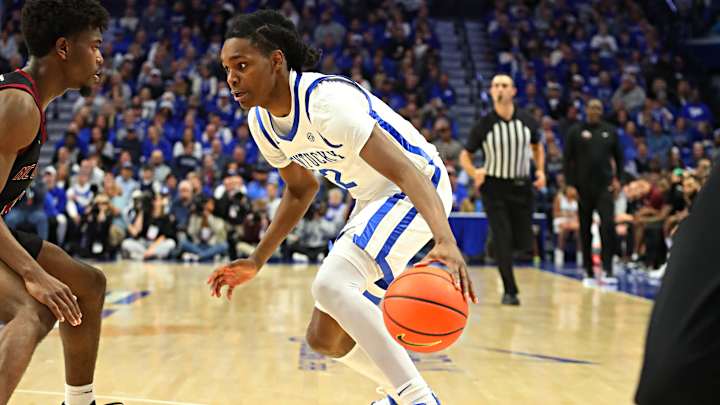
Be ready for the battle.
When you zoom out, Kentucky and Indiana look almost identical on paper. Indiana averages 88.2 points per game. Kentucky sits at 85.5. Both shoot close to 50 percent from the field, and both defend well enough to hover in the mid-60s in points allowed.
But rivalry games are rarely decided by surface-level numbers. When you dig deeper, a few pressure-point stats jump off the page—and if this matchup delivers on the hype, those numbers will tell the real story inside Rupp Arena.
Passing and ball movement
The first stat that matters is passing.
Kentucky averages 19.1 assists per game, a top-15 mark nationally, and owns one of the cleaner assist-to-turnover ratios in college basketball. On paper, that screams efficiency. In reality, that number has dipped sharply against power-conference opponents, when defenses are longer, more physical, and far more prepared. In those games, Kentucky has posted assist totals of 14, 13, 12, and even 8—nights when the offense bogs down into isolation basketball instead of flowing movement.
Indiana lives on the opposite end of that spectrum. The Hoosiers average 20.4 assists per game, ranking top three nationally, while still protecting the ball at an elite level. More importantly, Indiana allows only about 10 assists per game, a top-15 defensive number. Kentucky, by contrast, gives up 14.5 assists per night, ranking 226th nationally.
If Indiana’s ball movement survives the Rupp environment, open shots will be there all night. Kentucky’s only counter is disruption—on-ball pressure, sharper rotations, and turning passes into rushed decisions and live-ball turnovers. If the Cats are even half a step slow, Indiana will carve them up.
How the game starts
The second swing stat is the opening 20 minutes.
Indiana has been one of the nation’s best first-half teams, averaging 44.2 points while holding opponents to just 28.6. Kentucky’s starts have been far more uneven. The Cats average 40.2 first-half points and allow just over 30, which sounds respectable—until you factor in how often Rupp has felt flat early this season.
Slow starts don’t just affect the scoreboard. They affect the building. When Kentucky opens games searching for rhythm, the crowd never quite reaches full volume, and tension creeps in. Against a confident, connected team like Indiana, that’s dangerous.
Kentucky cannot afford to spend the first 10 minutes feeling things out while Indiana hits rhythm threes and back-cut layups. If the Hoosiers walk into halftime with a double-digit lead, Rupp gets quiet in a way road teams can feel—and that’s when belief shifts.
The rebounding edge
The third—and maybe most important—area is the glass.
Indiana is not a strong offensive rebounding team. The Hoosiers average just 7.5 offensive boards per game, ranking 301st nationally. Their defensive rebounding is solid but not dominant.
Kentucky, on the other hand, has been elite on the defensive glass, averaging 28.4 defensive rebounds per game and limiting opponents to just 8.3 offensive rebounds. That’s a real advantage.
Where Kentucky has fallen short is on its own offensive glass. The Cats average about 10.1 offensive rebounds per game and can go long stretches without creating second-chance points. If there’s a night to change that, this is it. Even a modest bump in extra possessions could flip momentum,
