


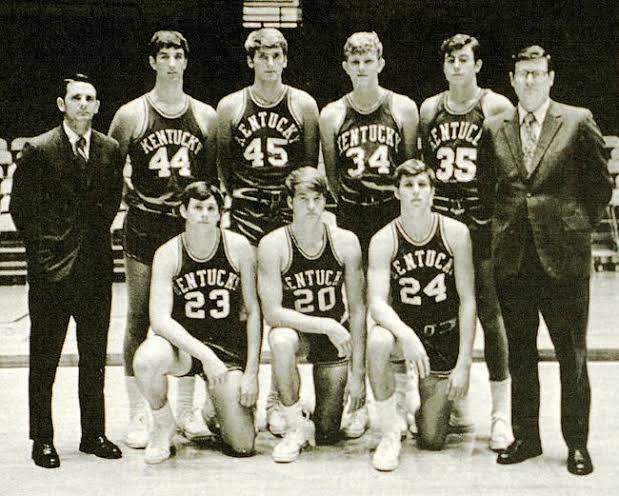
Following a disappointing 3-10 campaign in 1922-23, the Kentucky Wildcats were in need of a turnaround. With offensive struggles plaguing the team — they averaged just 21 points per game over 13 contests — head coach George Buchheit faced mounting pressure to get the program back on track. Fortunately, the 1923-24 season would mark a significant rebound, capping Buchheit’s tenure in Lexington on a high note.
Buchheit’s Final Season in Blue
George Buchheit, who took over the Wildcats program in 1919, quickly made a name for himself by leading Kentucky to their most successful seasons to date. Over his five-year stretch, he compiled an overall record of 44-27. The 1923-24 season would be his last at the helm, as he departed afterward to coach the Duke Blue Devils. Although his time at Duke wouldn’t match his Kentucky success — he went 25-36 in four seasons — Buchheit left Lexington having laid the foundation for a rising basketball powerhouse.
New Opponents, New Era
The 1923-24 season introduced several first-time matchups for Kentucky. The Wildcats squared off against West Virginia, Virginia Tech, Georgia Tech, and North Carolina for the first time in school history. These games added fresh competition and began building the foundation of what would become traditional southern basketball rivalries.
Youth Movement Sparks Success
To recover from the prior year’s letdown, Kentucky leaned on a talented sophomore trio to carry the load. James McFarland emerged as the team’s leading scorer, with fellow sophomores Will Milward and Lovell Underwood providing key support. It was a young team, but one that brought renewed energy and scoring prowess.
1923-24 Wildcats Roster & Scoring Averages
James McFarland (Soph): 10.0 ppg
Will Milward (Soph): 5.27 ppg
Lovell Underwood (Soph): 5.14 ppg
Carl Riefkin (Sen): 4.60 ppg
William King (Jun): 3.44 ppg
Hendryx (unknown): 2.33 ppg
William Wilkinson (Jun): 2.00 ppg
Charles Hughes (Jun): 1.31 ppg
A.T. Rice (Jun): 1.13 ppg
Charles Albert (Soph): 1.00 ppg
William Poyntz (Sen): 1.00 ppg
C. Foster Helm (Soph): 0.88 ppg
Ralph Boren (Jun): 0.22 ppg
Game-by-Game Recap
The Wildcats began the season with a dominant 33-13 victory over a short-handed Vanderbilt squad. Wins over Mexico City YMCA and Georgetown College followed, signaling a promising start.
Kentucky then suffered a narrow 17-16 loss to Mississippi A&M, falling just short after a second-half comeback attempt. They quickly rebounded with a resounding 50-15 win over Sewanee, but another setback came in the form of a 20-13 loss to Tennessee, where the Vols’ defense stifled Kentucky’s attack.
A tight 24-23 win over Tennessee-Chattanooga featured a 16-point performance by McFarland. That was followed by Kentucky’s first-ever matchup with West Virginia — a hard-fought 24-21 victory.
The Wildcats then caught fire, rolling through Centre College, Georgetown College again, and Clemson (38-13). A 29-16 win over Virginia extended the streak, with McFarland scoring another 16 points.
In their debut matchup with Virginia Tech, every Kentucky player contributed points in a 36-14 rout. Another victory over Centre and a 33-27 win over Georgia Tech closed out the regular season on a high note — nine straight wins heading into postseason play.
Tournament Play & Season Finale
Kentucky entered the Southern Conference Tournament brimming with confidence. However, their season came to a close in the first round with a 41-20 loss to North Carolina. The Tar Heels jumped out early and never relinquished the lead, ending Kentucky’s postseason hopes.
Final Record: 13-3
Departing Seniors
Several players finished their Kentucky careers in 1924:
Carl Riefkin went on to work in the steel industry and eventually became a vice president. An avid horse racing fan, he even owned a Preakness Stakes winner. He passed away in 1977.
William Wilkinson became the headmaster at the Huntington School for Boys in Boston, retiring after a long career in education. He lived to the age of 88.
William Poyntz, a four-year player, passed away in Michigan in 1960.
Ralph Boren pursued a career in civil engineering and died in 1978.
The 1923-24 season stands as a pivotal year in Kentucky basketball history — a bounce-back campaign that helped launch the program toward its future successes. With a new generation of talent and strong leadership, the Wildcats were beginning to establish their identity as a national power.
