


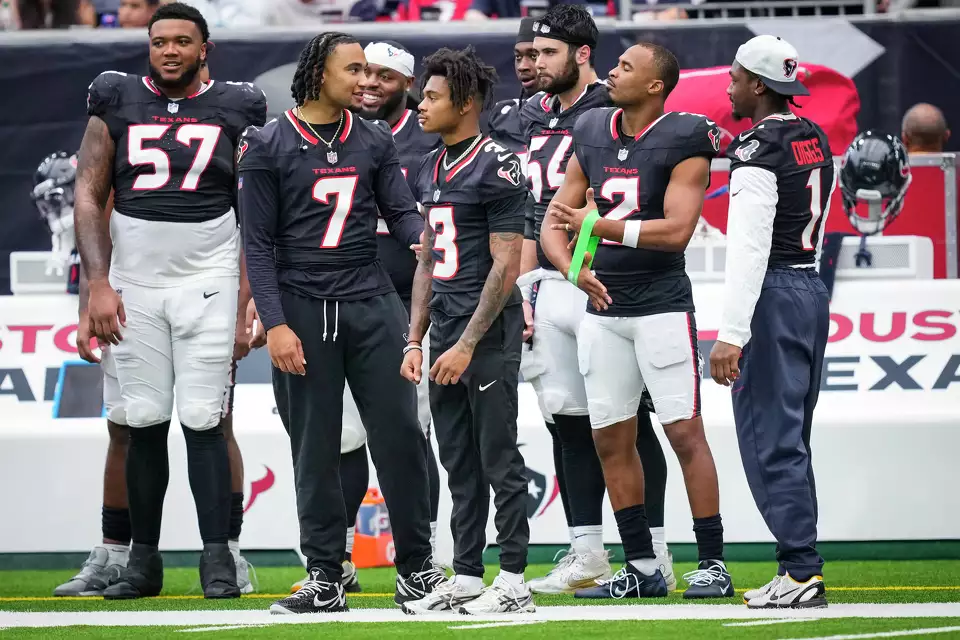
The Houston Texans entered 2024 with a potential juggernaut offense given last year’s success and the offseason influx of talent. C.J. Stroud and Co. are struggling to be even a league average offense in recent weeks.
Houston settled for a late field goal in a 24-22 Week 7 loss at the Green Bay Packers, then survived a 23-20 Week 8 win over the Indianapolis Colts.
The Texans’ attack then slumped for much of the 21-13 Week 9 loss at the New York Jets on Thursday Night Football. The last contest was the most concerning. Stroud was pressured on 47.8 percent of dropbacks, sacked eight times and struggled with his usual-pinpoint accuracy as he was harassed time and again in the second half. Houston generated just three plays of 20-plus yards, and it didn’t find the end zone in the second half.
Stroud and the Texans were shut out in a 30-0 loss at MetLife Stadium last season. Given the expectations of the 2024 team, Thursday’s defeat was perhaps more dispiriting.
Houston still sits 6-3 and atop the AFC South despite the most recent meltdown in the Meadowlands. Yet it’s hard to shake the notion that the current iteration of the Texans is a notch below the Kansas City Chiefs and the Baltimore Ravens in the AFC hierarchy. An opportunity for upgrades awaits, with a likely flurry of trades ahead before Tuesday’s 3 p.m. CT trade deadline. As for the Texans, specifically, two position groups stand as the greatest area of need. Will we see general manager Nick Caserio improve either group by late Tuesday? Let’s assess the odds for each:
An intermediate threat?
Houston’s wide receiving corps was effectively overmatched in Week 9, and understandably so given the absences of both Stefon Diggs and Nico Collins. The expected return of Collins in Week 10’s home game against the Detroit Lions should open up Houston’s passing attack, bringing back one of the NFL’s best deep targets. Diggs’ absence—which will extend through the rest of the 2024 season—brings a challenge in a different area of the field. Diggs recorded a first down on 31 receptions in eight games this season, more than all but two receivers league-wide. He’s considered one of the NFL’s best short and intermediate receivers, an elite route runner with “wicked hands,” per Houston defensive coordinator Matt Burke.
Losing Diggs is a serious blow to Houston’s Super Bowl hopes. Whether the Texans have the internal depth to withstand his injury without a trade is now the more pressing question.
Subtract Collins from this lineup, and I’d quickly sound the alarm. The 6-foot-4 wideout is Houston’s one true irreplaceable receiver, a player who can change a game on a single play.
Diggs, while still a technician, doesn’t sport the same gamebreaking ability, nor is he a player who can’t be at least partially replicated in the aggregate. Expect Tank Dell to receive additional looks on slants, curls and intermediate in-breaking routes (which we saw early and often at New York before a second-half sputtering).
As for a feasible third receiver next to Collins and Dell, Houston’s bullish words about Xavier Hutchinson aren’t totally bluster. Hutchinson was a major producer in college with a pair of 1,000-plus yard seasons at Iowa State. Stroud and Hutchinson both noted in recent weeks their growing chemistry, and, like Collins ,Hutchinson is a strong ball-winner at 6-foot-2.
Again, no single receiver will replace Diggs. Any trio or quartet of replacements could also fall short. But pair Hutchinson and speedster John Metchie with the return of Collins, and Houston’s receiving corps is still a viable group. I’d be surprised if Caserio deals any sort of sizable draft capital for a wideout before Tuesday’s lineup.
